Gleason Insurance Brokers

General Liability · Workers' Comp · Commercial Auto · Pollution Insurance · Surety Bonds Start a Business Insurance Quote Today

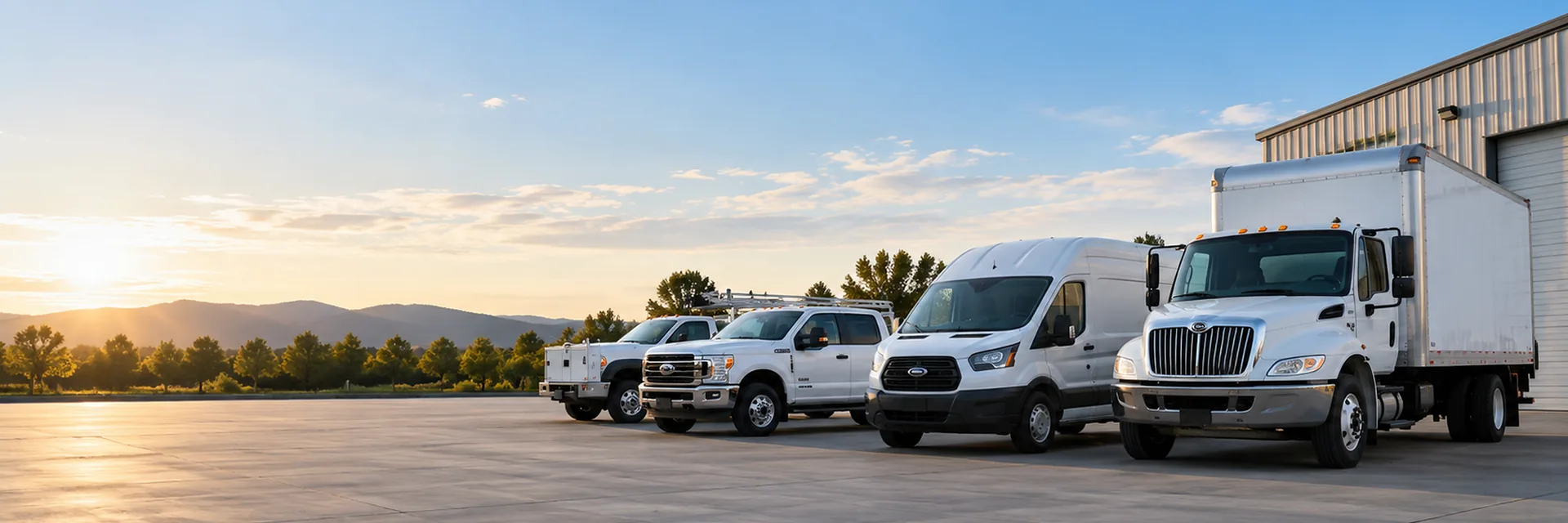
A fleet of commercial work vehicles parked in a row — commercial auto insurance for California contractors

California commercial insurance

Commercial Auto Insurance Contractors CA

844-97-USAVE

A truck insured on a personal auto policy is a gap waiting to happen the moment it's used for business — hauling materials, carrying crews, or titled to the company. Commercial auto is built for exactly that use, with liability limits sized to what a work vehicle can actually cause, not just what it's worth. Working with a local, independent agency instead of a single-carrier agent means faster comparisons and more affordable options for your construction projects.

  • Owned Business Vehicles
  • Physical Damage
  • Hired & Non-Owned

Reviewed by David Gleason, Principal — October 11, 2026

Next Level Experience. Insurance Done Right.

CaliforniaGeneral information only, not legal advice — illustrative scenarios and coverage, subject to change without notice. Content may be out of date or contain errors, and requirements vary by city, county, state, agency, project, contract, carrier and policy, among other factors; verifying what applies to your own situation is your responsibility. Full disclaimer

Interactive coverage guide

Build a coverage stack around how the business actually operates.

Start with the preselected industry or trade, then adjust the operational questions. The commonly considered stack updates live. Keep the coverages you want GIB to evaluate, remove ones you do not want included in your quote request, and add other available lines before continuing.

Common Starting Coverages

General LiabilityThird-party injury and property damage

What it is

General Liability commonly addresses covered third-party bodily injury, property damage and certain personal or advertising injury claims, subject to the policy.

Why businesses like yours commonly carry it

Businesses commonly use it as a starting liability policy and to satisfy customer, landlord or contract requirements.

Possible coverage gap

General Liability is not intended to replace policies for employee injuries, business vehicles, owned property, cyber events or professional errors.

Learn more about General Liability

Commonly Added Based on Operations

Contractor Equipment / Inland MarineMobile tools, equipment and property away from premises

What it is

Inland Marine is commonly used for tools, equipment and certain mobile property that moves between locations or jobsites.

Why businesses like yours commonly carry it

Contractors frequently move tools, testing equipment and mobile machinery among jobsites.

Possible coverage gap

General Liability should not be assumed to insure the business's own tools and equipment against theft or physical damage.

Learn more about Contractor Equipment / Inland Marine
Cyber Liability & Data BreachCyber events, data and system interruption

What it is

Cyber insurance may address certain first-party and third-party losses from covered data breaches, cyberattacks, ransomware and system interruption, depending on the policy.

Why businesses like yours commonly carry it

Contractors commonly use email, electronic banking, project platforms, payroll systems and cloud document storage.

Possible coverage gap

General Liability generally should not be assumed to address data breach response, ransomware or network interruption.

Learn more about cyber insurance for contractors

Exposure-Dependent Coverages

Installation FloaterMaterials awaiting or undergoing installation

What it is

An Installation Floater may cover certain materials and equipment in transit, temporary storage and during installation, subject to the policy.

Why businesses like yours commonly carry it

Businesses responsible for materials before final installation commonly consider this coverage.

Possible coverage gap

A basic liability policy generally should not be assumed to cover the insured's materials against physical loss before installation is complete.

Learn more about Installation Floater
Builder's RiskProject property during construction

What it is

Builder's Risk may insure covered buildings, materials and certain project property while construction is underway.

Why businesses like yours commonly carry it

Owners, developers and contractors commonly consider it when a structure or major renovation is exposed during construction.

Possible coverage gap

Commercial Property and General Liability are not automatic substitutes for course-of-construction property coverage.

Learn more about Builder's Risk
Contractors Pollution LiabilityPollution conditions and cleanup liability

What it is

Pollution Liability may address covered cleanup costs and third-party injury or property damage arising from pollution conditions.

Why businesses like yours commonly carry it

Businesses working with fuels, chemicals, soil, water, demolition or environmental conditions may have pollution exposures.

Possible coverage gap

Standard General Liability commonly contains pollution exclusions or limitations.

Learn more about Contractors Pollution Liability
Umbrella / Excess LiabilityAdditional limits above scheduled liability policies

What it is

Umbrella or Excess Liability may provide additional limits above identified underlying liability policies, subject to its own terms and exclusions.

Why businesses like yours commonly carry it

Businesses with larger contracts, vehicles, public exposure or higher severity potential commonly consider additional limits.

Possible coverage gap

An umbrella does not automatically broaden every exclusion or sit over every policy unless the issued terms say it does.

Learn more about Umbrella / Excess Liability

Loading quote and requirements options…

Educational guidance only. Results are not a coverage recommendation, quote, binder, policy interpretation, or guarantee of coverage. Actual needs, availability, forms, limits, exclusions and requirements vary. A licensed insurance professional should review the complete risk and issued policy terms.

Verified Google reviews

What contractors say about us

5.0 / 5from 7 Google reviews

Reviews reflect individual client experiences and are not a guarantee of coverage, pricing or results.

91 Enterprise LLC

91 Enterprise LLC

March 24, 2026

We are using Gleason insurance for our commercial auto policy and GL policy. David is the best insurance broker I've worked with — very honest, responsive, and knowledgeable. Highly recommend.

Fito Plumbers

Fito Plumbers

February 20, 2026

We have been working with David at Gleason Insurance Brokers for 8+ years. David always goes above and beyond to make sure we have the appropriate coverages. He explains everything in detail and makes sure we feel confident and understand all of our policies. He is always available and responds right away!

Barry Stay

Barry Stay

February 17, 2026

David provides great service and I highly recommend him for your insurance needs.

Why a personal policy usually isn't enough

Personal auto policies are underwritten around personal, non-business use, and many specifically exclude or limit coverage once a vehicle is used substantially for business — hauling tools or materials, transporting employees, or carrying meaningful upfit equipment.

Read more

The exclusion turns on actual use, not just who the vehicle is titled to.

A loss involving business use that wasn't disclosed on a personal policy application risks denial, not just a coverage gap for the future — this is one of the more common and most expensive mistakes a growing contracting business makes without realizing it.

Personal policies often exclude or limit substantial business use
The exclusion is based on actual use, not vehicle title alone
Undisclosed business use risks denial of an actual claim
Business use commonly creeps in gradually as a company grows

What commercial auto is built to handle

Commercial auto is underwritten for business use from the outset — job-site travel, multiple drivers, higher mileage patterns and materials transport are expected, not exceptions that trigger an exclusion.

Read more

Liability limits are also typically higher and more flexible than what a personal policy offers.

Physical damage coverage — collision and comprehensive for the insured vehicle itself — is usually written alongside liability, and tools or equipment carried in the vehicle may need separate inland marine coverage rather than being automatically included.

Underwritten for job-site travel and business use as the norm
Higher, more flexible liability limits than personal auto
Physical damage coverage insures the vehicle itself
Tools/equipment in the vehicle may need separate inland marine coverage

What actually drives commercial auto pricing

Vehicle weight, business use, radius of operation, territory, driver records and claims history all factor into pricing — and liability exposure, not the vehicle's value, is usually the bigger driver.

Read more

A relatively inexpensive heavy truck can still create a very large liability exposure through the bodily injury and property damage it could cause to others.

Written driver criteria — acceptable MVR standards, limits on major violations, minimum experience, periodic MVR review — is one of the more direct levers a contractor has on long-term commercial auto pricing, separate from the vehicles themselves.

Liability exposure, not vehicle value, drives most of the premium
Radius, territory and driver records all factor into pricing
Written driver criteria helps control rates over time
Report new drivers before they start driving, not after

USDOT, CA numbers and motor carrier compliance

Depending on vehicle weight, interstate operations and cargo, a USDOT number, a separate California CA number, or a California Motor Carrier Permit may apply — the three are not interchangeable, and some operations need more than one.

Read more

Applicability should be confirmed with FMCSA and California DMV Motor Carrier Services directly, not assumed from a similar business.

Operating without required registration, permits or current inspections can result in enforcement action independent of the liability, comprehensive and collision coverage the vehicle otherwise carries — insurance and regulatory compliance are related but separate requirements.

USDOT number, CA number and MCP are three separate registrations
Applicability depends on vehicle weight and operation, not assumption
Confirm directly with FMCSA and California DMV Motor Carrier Services
Compliance issues can trigger enforcement independent of insurance
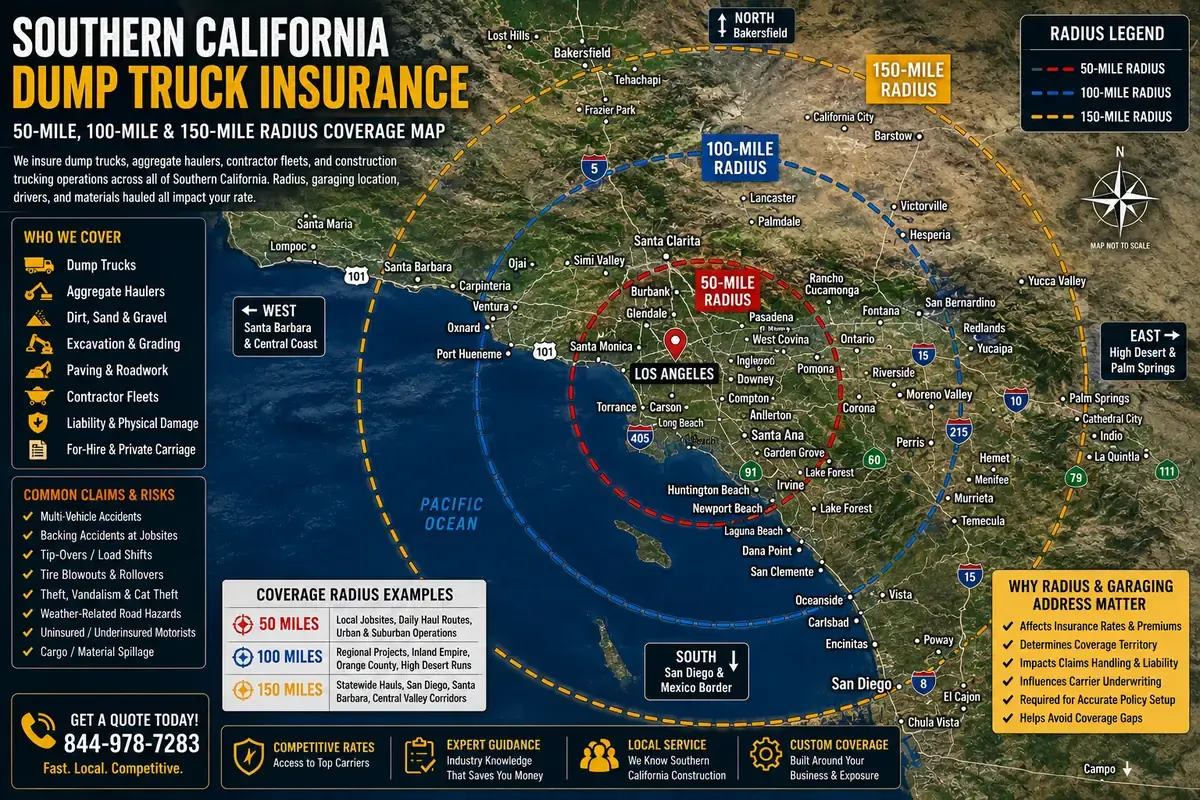
Southern California dump truck and material hauler insurance coverage radius map — 50, 100 and 150-mile operating zones from Gleason Insurance Brokers

One Stop · We Shop · Real Results

844-978-7283
  • Dump trucks
  • Aggregate haulers
  • Dirt, sand and gravel
  • Excavation and grading
  • Paving and roadwork
  • Contractor fleets
  • Liability and physical damage
  • For-hire and private carriage
  • Multi-vehicle accidents
  • Backing accidents at jobsites
  • Tip-overs and load shifts
  • Tire blowouts and rollovers
  • Theft, vandalism and catalytic converter theft
  • Weather-related road hazards
  • Uninsured and underinsured motorists
  • Cargo and material spillage
  • Affects rates and premiums
  • Determines coverage territory
  • Impacts claims handling and liability
  • Influences carrier underwriting
  • Required for accurate policy setup

50 miles — Local jobsites, daily haul routes, urban and suburban operations

100 miles — Regional projects, Inland Empire, Orange County, High Desert runs

150 miles — Statewide hauls, San Diego, Santa Barbara, Central Valley corridors

Radius, garaging location, drivers and the materials hauled can all influence commercial insurance pricing and underwriting eligibility. The zones shown describe how far this agency places coverage; they are not a statement of what any policy covers.

A realistic claims scenario

A crew truck backing out of a residential jobsite clips a parked car and damages a neighbor's mailbox — a routine, low-severity incident, but one that immediately raises the question of whose policy responds.

Read more

If the truck is titled to the business and used primarily for work, a personal auto policy can deny the claim outright as a business-use exclusion, leaving the loss uncovered at the worst possible moment.

Commercial auto is written specifically to expect this kind of use — job-site maneuvering, towing, multiple drivers — so the claim is handled as ordinary business, not treated as evidence the vehicle was misclassified from the start.

This scenario is a typical illustration, not an actual case or a guaranteed result — every real claim is evaluated on its own policy language and facts. Nothing here should be read as legal advice; for case-specific questions, consult a licensed attorney or the appropriate regulatory authority having jurisdiction.

A business-titled, work-used vehicle risks denial on a personal auto policy
Business-use exclusions are common and enforced, not a technicality
Commercial auto expects jobsite use as ordinary, not exceptional
The gap shows up exactly when a claim is filed, not before

Hired and non-owned auto: the gap most contractors miss

A contractor who rents a truck for a specific project, or whose employee uses a personal vehicle to run to the supply yard, has exposure a standard commercial auto policy — written around owned, scheduled vehicles — often doesn't automatically extend to.

Read more

Hired and non-owned auto (HNOA) coverage closes exactly that gap.

This is one of the most commonly missing coverages for smaller contracting operations specifically because it's easy to assume the main commercial auto policy already handles it — confirming HNOA is explicitly in the program, not assumed, is worth a direct conversation with your broker.

Rented trucks and employee personal-vehicle use aren't automatically covered
HNOA closes the gap standard commercial auto often leaves open
Commonly missing for smaller operations that assume it's included
Worth confirming explicitly rather than assuming

Building a fleet program that keeps up with the business

A single work truck insured correctly today can outgrow that coverage as the business adds vehicles, drivers, and mileage — revisiting the program as operations change is what keeps a fleet program accurate instead of drifting out of sync with the actual fleet.

Read more

Gleason Insurance Brokers places commercial auto for contractors and transportation businesses across California, Arizona, Nevada, Texas and Utah — call 844-978-7283 or request a quote with your vehicle and driver schedule to get started.

Revisit fleet coverage as vehicles, drivers and mileage grow
Schedule new vehicles and drivers promptly, not at renewal
Fleet programs available across CA, AZ, NV, TX and UT
Call 844-978-7283 or request a quote with your vehicle schedule
HVAC and mechanical service fleets carry their own real mix of vehicle types and use patterns — see our HVAC / Mechanical / Refrigeration Contractor Insurance California guide for what's specific to that trade's fleet

Fleet coverage for established, growing operations

This is where growth shows up first for a lot of contractors: a sand and gravel or dump truck operation that's built up a fleet past five trucks and is pushing toward $3 million or more in annual revenue has a materially different commercial auto and umbrella exposure than the same business had at two or three trucks.

Read more

Physical damage schedules, hired/non-owned auto exposure, and umbrella limits that follow form over the auto policy all need to be reviewed as the fleet grows — not just renewed at last year's numbers.

Paving and grading contractors hauling their own equipment carry a related but distinct exposure — the tow vehicle is commercial auto, but the equipment being hauled is typically an inland marine question, and the two need to be coordinated so nothing falls into a gap between them. Getting this right matters more, not less, as the fleet and the equipment schedule both grow at the same time. Contractors running dump trucks, water trucks or flatbeds alongside pickups can review contractor truck insurance.

Fleet growth past 5 trucks / $3M+ revenue typically requires an umbrella and auto limits review
Physical damage schedules should be reviewed as the fleet grows, not renewed at last year's figures
Towed equipment is usually an inland marine question, separate from the tow vehicle's auto coverage
Hired and non-owned auto exposure grows with the business even before new trucks are titled

Public works and prevailing wage impact on fleet operations

A growing fleet operation bidding public works projects for the first time takes on more than just a bonding and insurance-limit question — prevailing wage requirements apply to CDL drivers and equipment operators on public-funded jobs, which affects payroll classification and, indirectly, how the operation's overall risk profile is evaluated at renewal.

Read more

This is worth understanding before bidding public work with a growing fleet, not after a payroll audit raises questions about classification.

Grading and excavation crews working near utilities on public projects carry an additional consideration worth flagging to your broker directly: coordinating fleet and equipment coverage with utility strike prevention practices, since a strike involving a company vehicle or towed equipment sits at the intersection of auto, inland marine and general liability rather than falling cleanly under just one policy.

Prevailing wage applies to CDL drivers and operators on public-funded projects
Understand the payroll classification impact before bidding public work with a growing fleet
A utility strike involving a vehicle or towed equipment can span auto, inland marine and GL at once
Coordinate fleet coverage with utility strike prevention practices on grading/excavation public jobs

Physical damage and cargo coverage for equipment transport

Paving and grading contractors that haul their own equipment between job sites carry a coverage question worth getting right early: the truck is a commercial auto exposure, but the equipment being hauled — and any cargo or materials on the trailer — usually falls under a separate inland marine question, not the auto policy.

Read more

Assuming the auto policy covers the towed equipment is one of the more common gaps we see, and it typically isn't discovered until equipment is damaged in transit.

As a fleet and its equipment schedule both grow, this coordination becomes more important, not less — more vehicles hauling more (and more valuable) equipment means more exposure sitting at the intersection of two different coverage lines. A single combined review of the auto schedule and the equipment/inland marine schedule at renewal is the simplest way to confirm nothing is falling into the gap between them.

The tow vehicle is commercial auto; the equipment and cargo it's hauling is usually inland marine
Assuming the auto policy covers towed equipment is a common, easy-to-miss gap
This gap typically isn't discovered until equipment is damaged in transit
Review the auto schedule and the equipment schedule together at renewal, not separately

"Full coverage" is not a policy, and it does not mean unlimited

The phrase comes from personal auto and follows people into commercial work.

Read more

No carrier issues a policy called full coverage — it is not a form, not a coverage part and not a limit. In ordinary use it means liability plus comprehensive and collision, so damage to the contractor's own vehicle is addressed alongside damage caused to somebody else. That is a useful shorthand for what is on the policy. It says nothing about how much.

Every piece of it still carries a stated number. Liability responds up to the limit that was selected, commonly written as a combined single limit. Comprehensive and collision respond to the vehicle itself, generally up to its actual cash value or a stated amount, less the deductible — and they do not raise the liability limit, because they are not liability coverage. A vehicle described as having full coverage is a vehicle with a particular set of coverages on it, each with its own ceiling.

It also does not mean everything connected to the vehicle is addressed. The freight being hauled sits on motor truck cargo coverage; vehicles the business does not own but its people drive sit on hired and non-owned auto; tools and equipment being transported usually belong on contractor equipment and inland marine coverage; and a spill from a truck is a pollution liability question. None of those arrives because somebody added comprehensive and collision.

The limits themselves are chosen rather than standard. They get selected against the operation's own risk tolerance and against what the projects, contracts, owners and general contractors being worked for actually request — and a limit that satisfied one agreement is not automatically what the next one asks for. Coverage, availability and the limits that can be offered are determined by the policy as issued and the carrier writing it.

"Full coverage" is a habit of speech, not a coverage form — no carrier issues one
In ordinary use it means liability plus comprehensive and collision, which describes what is on the policy, not how much
Physical damage generally responds up to the vehicle's actual cash value or a stated amount, less the deductible
Cargo, hired and non-owned auto, equipment being hauled and pollution from a spill are each separate questions
Limits are selected against your own risk tolerance and what each project, owner or general contractor requests

Fleet administration is the real ongoing job, not just the policy

A commercial auto policy is easy to buy once.

Read more

Keeping it accurate as a fleet grows is the harder, ongoing part — drivers joining and leaving, vehicles bought, sold or taken home, a change in operating radius, trailers and equipment that were never formally scheduled, an MVR issue that surfaces on one driver, and telematics data that exists but isn't being used to actually manage risk or support a renewal. Auto has been one of the more rate-pressured lines in construction, and an unmanaged fleet file is what makes that pressure worse at your specific renewal.

We keep a live driver and vehicle roster tied to your actual operation, run MVRs on a scheduled basis rather than only at hire, flag vehicle changes as they happen instead of at audit, and put your safety documentation and telematics data to use as an underwriting-ready file — so a renewal conversation starts from an accurate picture instead of a scramble to reconstruct one.

Not sure whether a work truck actually needs a commercial policy instead of a personal one? See Commercial Auto vs. Personal Auto for Work Trucks for how carriers actually draw that line. Running an enclosed straight truck instead of a pickup or van? See our dedicated Box Truck Insurance California page for cargo, liftgate and moving-specific coverage.

Driver and vehicle changes tracked as they happen, not discovered at audit
Scheduled MVR reviews, not just a one-time check at hire
Trailers and equipment scheduled correctly, not left off the policy
Telematics and safety documentation used as an underwriting-ready file

From our case files: two auto claims that surprised the owner

A general contractor insured for $1,000,000 in auto liability, with nothing for comprehensive or collision, had a driver cause an accident.

Read more

The other driver's damages were paid; the company's own truck was repaired out of pocket, because liability coverage does not pay for the insured's own vehicle (case study 8).

In another claim, a contractor's truck was pushed into the car ahead during a multi-car rear-end chain that someone else started. After investigation and lengthy litigation, the contractor's policy still paid for the car in front — a six-figure loss that raised the fleet's premium (case study 9). In a pile-up, who pays isn't always decided by who started it.

Frequently asked questions

25 questions — start typing to filter

Do contractors need commercial auto insurance?

If vehicles are owned, leased, hired or regularly used in business operations, commercial auto insurance may be necessary. The appropriate coverage depends on vehicle ownership, vehicle type, gross vehicle weight, business use, radius, drivers, materials or equipment transported, and state and federal motor-carrier requirements.

How soon should I add a newly hired driver?

Notify your insurance professional as soon as possible and follow the carrier's driver-reporting and approval requirements. For carriers requiring driver approval, waiting until after the employee begins driving can create problems.

How can I help control my commercial auto insurance rates?

Driver selection and fleet management can have a major impact — consider written driver criteria such as acceptable Motor Vehicle Record standards, maximum allowable violations, restrictions on major violations, minimum driving experience, driver training, accident reporting, vehicle-use policies and periodic MVR review. Pricing also depends on vehicle type, radius, territory, claims, fleet size and operations.

What is physical damage coverage for my commercial truck?

Physical damage generally includes coverage such as collision and comprehensive for damage to an insured vehicle, subject to the policy, deductible and exclusions.

Does liability-only commercial auto insurance cover damage to my own truck?

Generally, liability coverage is intended to address covered bodily injury or property damage for which the insured is legally liable to others — it generally does not pay to repair the insured's own vehicle simply because it was damaged in an accident. Physical damage coverage is typically used to insure the vehicle itself.

Why is commercial auto insurance so expensive in California?

Rates can be affected by claims frequency, claims severity, litigation costs, medical costs, repair costs, vehicle weight, business use, geographic territory, driver records, radius, loss history, and the type of cargo or operation. Pricing is based on much more than the value of the vehicle — a relatively inexpensive heavy truck can still create a very large liability exposure through the bodily injury and property damage it could cause to others.

Do I need a USDOT number?

Possibly — USDOT requirements depend on vehicle type, weight, interstate operations, cargo, passenger operations and other federal requirements. Verify applicability with FMCSA.

How does prevailing wage affect commercial auto and driver payroll on public works jobs?

Prevailing wage requirements apply to CDL drivers and equipment operators on public-funded projects, which affects payroll classification and can indirectly influence how the fleet's overall risk profile is evaluated — worth understanding before bidding public work with a growing fleet, not discovering it during a payroll audit.

Is towed equipment covered under commercial auto, or does it need separate coverage?

Generally the tow vehicle itself is a commercial auto question, while the equipment being hauled is typically an inland marine question — the two need to be coordinated so nothing falls into a gap between them, which becomes more important as both the fleet and the equipment schedule grow at the same time.

Should I use an insurance agent or an independent broker for commercial auto insurance in California?

An agent typically represents one insurance company; an independent broker like Gleason Insurance Brokers can shop commercial auto insurance across multiple carriers on your behalf. For contractors juggling several construction projects at once, that usually means more options to compare, not just one company's terms.

Do BIT inspections affect a contractor's commercial auto insurance?

Not directly, but the records do. CHP's Biennial Inspection of Terminals rates maintenance, driver records and vehicle condition at California truck terminals, and those are the same records an underwriter asks a contractor's fleet to produce, so a clean history tends to help a submission even though no carrier requires one. Whether the program reaches your operation at all depends on the vehicles you run rather than on being a contractor — a mixed fleet of pickups and a couple of heavy trucks is worth confirming with CHP rather than assuming out of scope. On the emissions side, CARB's Board voted on September 25, 2025 to repeal the Advanced Clean Fleets high-priority and drayage fleet requirements, and CARB's current guidance says private fleets are not subject to the remaining state and local government fleet rules — other CARB truck rules can still apply to specific vehicles, so confirm the current position with CARB.

How do I compare commercial auto insurance companies for a contractor fleet?

Start with coverage fit, not just price: confirm the commercial auto insurance policy actually matches your vehicle types, radius of operation, and any Motor Carrier Permit (MCP) or DOT filings required, since an affordable commercial auto insurance quote that's missing a required endorsement isn't actually a good value once a claim happens. As an independent broker, Gleason Insurance Brokers can compare multiple California commercial auto insurance markets side by side rather than presenting just one company's terms.

Do you offer direct auto insurance access to more than one carrier?

Yes — Gleason Insurance Brokers maintains direct auto insurance relationships with multiple commercial auto carriers, so you don't have to contact each company separately to compare options. Instead of spending time reaching out to several carriers yourself, we do that legwork — going direct to the markets that fit your operation and bringing you real, comparable quotes to review.

Does commercial general liability insurance for contractors cover vehicle accidents on a jobsite?

Generally no — commercial general liability insurance for contractors typically excludes owned/scheduled vehicles, which is why a separate commercial auto policy exists specifically for that exposure, even on a jobsite.

Do bucket trucks need different commercial auto coverage than pickup trucks?

Vehicle type, weight class and use all factor into commercial auto underwriting — a bucket truck used for aerial tree work is a different risk than a standard pickup. See our C-49 tree and palm contractor insurance guide for the fleet considerations specific to this trade.

Does a larger fleet change how a contractor's whole insurance program is structured?

Yes — a larger fleet is a natural point to review the whole program together, including confirming Motor Carrier Permit (MCP) and DOT number status for every vehicle. Those requirements depend on vehicle weight and operation type, not fleet size, so a growing fleet is a good prompt to check rather than an automatic trigger on its own. See our guide on insurance for growing construction companies California for what changes at this scale.

Why does my commercial auto premium keep increasing even with no accidents?

Auto has been one of the more rate-pressured commercial lines industry-wide — but an unmanaged fleet file (unreported driver or vehicle changes, unscheduled trailers, MVR issues that go unaddressed) makes that underlying pressure worse at your specific renewal. Keeping the roster and safety documentation current is what you actually control.

Do I need to report every driver and vehicle change right away?

Yes — a driver added, a vehicle bought, sold or taken home, or a change in your typical operating radius all affect the policy. Reporting changes as they happen keeps the policy accurate and avoids a coverage gap or a larger-than-expected adjustment at audit.

What's the difference between business auto insurance and business vehicle insurance?

No real difference — both describe commercial auto coverage for vehicles used in business operations, as opposed to a personal auto policy. A personal policy typically excludes business use entirely, which is why a vehicle titled to or primarily driven for a business needs a business auto/vehicle policy, not a personal one.

What does an underwriter want to see for contractor auto insurance in California?

Gleason Insurance Brokers has strong, extremely competitive commercial auto markets for California contractors. Underwriters typically want to see at least one year of prior commercial auto insurance coverage at a minimum, with even more market options opening up at four years of continuous commercial auto coverage, and pricing is usually more favorable for an established fleet than for a single vehicle. Call 844-978-7283.

Are commercial vehicle insurance, business automobile insurance and commercial auto insurance the same thing?

Yes — commercial vehicle insurance, business automobile insurance, commercial auto insurance and commercial business auto insurance are all different common names for the same coverage: a business policy covering vehicles used for work rather than personal use, whether that's a single service truck or a full contractor fleet. What actually changes pricing and terms is vehicle weight, cargo, and how each vehicle is used — not which of these phrases you search.

Is Gleason able to find affordable business auto insurance?

Affordability in commercial auto insurance is never one-size-fits-all — it comes down to your specific risk profile. That said, business auto carriers price the same fleet very differently, and vehicle type, driver history, radius of operation and loss history are what actually determine where your operation lands. Call 844-978-7283 and we'll go direct to the markets built for your specific fleet.

If I cancel my commercial auto or trucking policy, am I still responsible for premium?

Not always right away. If the policy carries a state or federal motor carrier filing, the filing itself typically can't be canceled immediately — the regulating authority generally requires advance notice, often a minimum of 30 days from when they're notified, before the filing can be removed. You remain responsible for premium during that notice period, even if every vehicle on the policy, including the last or only vehicle carried on the filing, has already been sold or taken out of service.

Does "full coverage" mean I am covered for anything that happens?

No. Full coverage is not a policy or a coverage form — no carrier issues one. In ordinary use the phrase means liability plus comprehensive and collision, so the vehicle's own damage is addressed alongside damage caused to somebody else. Every part of it still carries a stated limit: liability responds up to the limit selected, and comprehensive and collision generally up to the vehicle's actual cash value or a stated amount, less the deductible. Cargo, hired and non-owned auto, and equipment being transported are separate questions again. The limits themselves are selected against your own risk tolerance and what a given project, owner or general contractor requests.

If I add comprehensive and collision, do my liability limits go up?

No. Comprehensive and collision are physical damage coverages — they respond to the vehicle itself. Liability responds to injury and damage caused to other people and their property, and it has its own separate limit. Raising one does not raise the other, and a contract asking for a particular auto liability limit is asking about the liability side regardless of what physical damage coverage is in place.

Additional official resources

Verify current licensing, regulatory and program requirements directly with the responsible agency — this is general information, not legal advice, requirements change without notice, and what is summarized here may be out of date or contain errors. Confirming what applies to your own city, project, contract and policy is your responsibility.

Explore Related Coverage and Contractor Resources

Related coverage
Guides, trades and resources

Updated October 11, 2026