Gleason Insurance Brokers

General Liability · Workers' Comp · Commercial Auto · Pollution Insurance · Surety Bonds Start a Business Insurance Quote Today

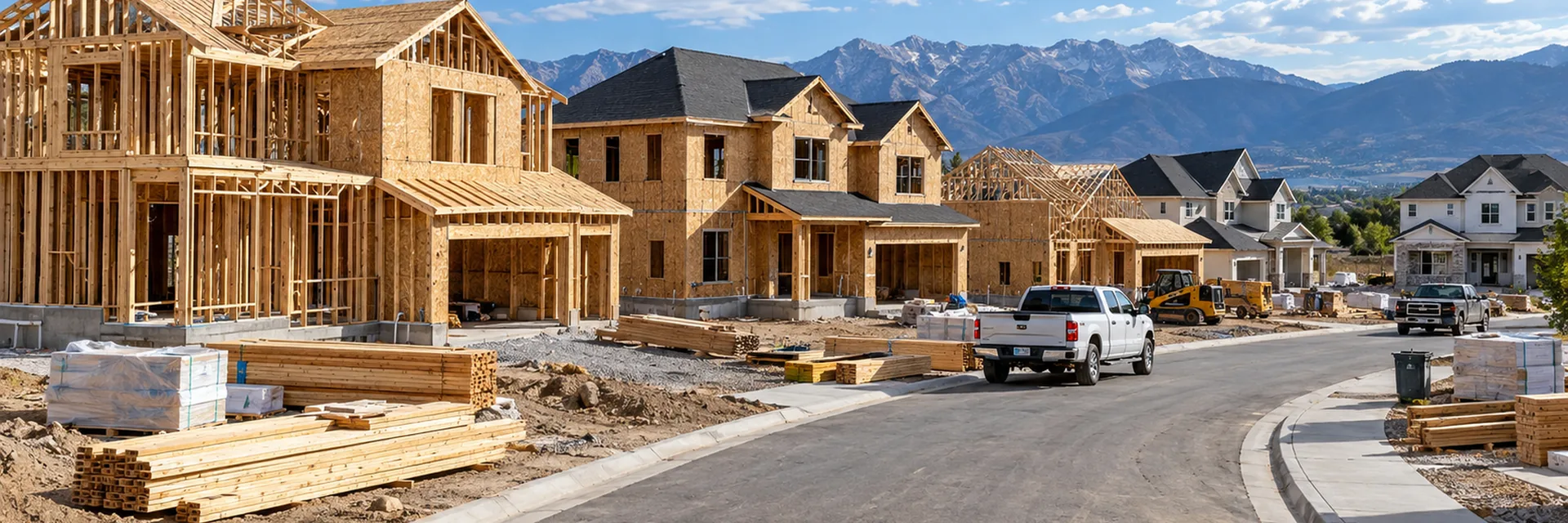
A residential street under construction with timber-framed houses at several stages, stacks of lumber on the lot and a contractor pickup parked at the curb, mountains behind — residential contractors

California commercial insurance

Residential Contractor Insurance California

844-97-USAVE

Residential contractor risk is built around the home itself — an occupied, lived-in structure with a homeowner (and often an HOA) watching every step, and a product/completed-operations exposure that follows the work for years after the last invoice is paid.

  • Right to Repair Act
  • Completed Operations Tail
  • Homeowner & HOA Claims

Reviewed by David Gleason, Principal — October 12, 2026

Next Level Experience. Insurance Done Right.

CaliforniaGeneral information only, not legal advice — illustrative scenarios and coverage, subject to change without notice. Content may be out of date or contain errors, and requirements vary by city, county, state, agency, project, contract, carrier and policy, among other factors; verifying what applies to your own situation is your responsibility. Full disclaimer

Interactive coverage guide

Build a coverage stack around how the business actually operates.

Start with the preselected industry or trade, then adjust the operational questions. The commonly considered stack updates live. Keep the coverages you want GIB to evaluate, remove ones you do not want included in your quote request, and add other available lines before continuing.

Common Starting Coverages

General LiabilityThird-party injury and property damage

What it is

General Liability commonly addresses covered third-party bodily injury, property damage and certain personal or advertising injury claims, subject to the policy.

Why businesses like yours commonly carry it

Businesses commonly use it as a starting liability policy and to satisfy customer, landlord or contract requirements.

Possible coverage gap

General Liability is not intended to replace policies for employee injuries, business vehicles, owned property, cyber events or professional errors.

Learn more about General Liability

Commonly Added Based on Operations

Contractor Equipment / Inland MarineMobile tools, equipment and property away from premises

What it is

Inland Marine is commonly used for tools, equipment and certain mobile property that moves between locations or jobsites.

Why businesses like yours commonly carry it

Contractors frequently move tools, testing equipment and mobile machinery among jobsites.

Possible coverage gap

General Liability should not be assumed to insure the business's own tools and equipment against theft or physical damage.

Learn more about Contractor Equipment / Inland Marine
Cyber Liability & Data BreachCyber events, data and system interruption

What it is

Cyber insurance may address certain first-party and third-party losses from covered data breaches, cyberattacks, ransomware and system interruption, depending on the policy.

Why businesses like yours commonly carry it

Contractors commonly use email, electronic banking, project platforms, payroll systems and cloud document storage.

Possible coverage gap

General Liability generally should not be assumed to address data breach response, ransomware or network interruption.

Learn more about cyber insurance for contractors

Exposure-Dependent Coverages

Installation FloaterMaterials awaiting or undergoing installation

What it is

An Installation Floater may cover certain materials and equipment in transit, temporary storage and during installation, subject to the policy.

Why businesses like yours commonly carry it

Businesses responsible for materials before final installation commonly consider this coverage.

Possible coverage gap

A basic liability policy generally should not be assumed to cover the insured's materials against physical loss before installation is complete.

Learn more about Installation Floater
Builder's RiskProject property during construction

What it is

Builder's Risk may insure covered buildings, materials and certain project property while construction is underway.

Why businesses like yours commonly carry it

Owners, developers and contractors commonly consider it when a structure or major renovation is exposed during construction.

Possible coverage gap

Commercial Property and General Liability are not automatic substitutes for course-of-construction property coverage.

Learn more about Builder's Risk
Contractors Pollution LiabilityPollution conditions and cleanup liability

What it is

Pollution Liability may address covered cleanup costs and third-party injury or property damage arising from pollution conditions.

Why businesses like yours commonly carry it

Businesses working with fuels, chemicals, soil, water, demolition or environmental conditions may have pollution exposures.

Possible coverage gap

Standard General Liability commonly contains pollution exclusions or limitations.

Learn more about Contractors Pollution Liability
Umbrella / Excess LiabilityAdditional limits above scheduled liability policies

What it is

Umbrella or Excess Liability may provide additional limits above identified underlying liability policies, subject to its own terms and exclusions.

Why businesses like yours commonly carry it

Businesses with larger contracts, vehicles, public exposure or higher severity potential commonly consider additional limits.

Possible coverage gap

An umbrella does not automatically broaden every exclusion or sit over every policy unless the issued terms say it does.

Learn more about Umbrella / Excess Liability

Loading quote and requirements options…

Educational guidance only. Results are not a coverage recommendation, quote, binder, policy interpretation, or guarantee of coverage. Actual needs, availability, forms, limits, exclusions and requirements vary. A licensed insurance professional should review the complete risk and issued policy terms.

Verified Google reviews

What contractors say about us

5.0 / 5from 7 Google reviews

Reviews reflect individual client experiences and are not a guarantee of coverage, pricing or results.

91 Enterprise LLC

91 Enterprise LLC

March 24, 2026

We are using Gleason insurance for our commercial auto policy and GL policy. David is the best insurance broker I've worked with — very honest, responsive, and knowledgeable. Highly recommend.

Fito Plumbers

Fito Plumbers

February 20, 2026

We have been working with David at Gleason Insurance Brokers for 8+ years. David always goes above and beyond to make sure we have the appropriate coverages. He explains everything in detail and makes sure we feel confident and understand all of our policies. He is always available and responds right away!

Barry Stay

Barry Stay

February 17, 2026

David provides great service and I highly recommend him for your insurance needs.

Why residential risk is different from commercial

A residential contractor's liability doesn't end at substantial completion the way it can feel like it does.

Read more

California's Right to Repair Act (Civil Code section 895 and following) sets statutory standards for new residential construction and gives homeowners a structured process to bring construction-defect claims years after the work is finished — a completed-operations exposure that runs on a much longer clock than most commercial trade work.

The homeowner relationship itself is also a distinct risk factor. Unlike a commercial GC or property manager who reviews certificates as a formality, an individual homeowner (or an HOA board on a multi-unit project) is often a first-time buyer of construction services, which raises the odds of a coverage or communication gap turning into a claim rather than a phone call. Tools stolen from a truck or an unlocked garage are a property loss, not a liability one; see tool theft and mobile equipment coverage.

California's Right to Repair Act (Civ. Code 895 et seq.) governs new residential construction-defect claims
Completed operations exposure runs for years after the job is finished, not just through the warranty period
Individual homeowners and HOA boards are less experienced insurance counterparties than commercial GCs
A clear written scope of work reduces the ambiguity that construction-defect claims are built on

Trades we commonly place on residential projects

A residential project draws on a specific mix of trades, and each one carries its own licensing and exposure profile even under the same homeowner's roof.

Read more

We place coverage for framing and drywall, roofing, plumbing, electrical, and HVAC and refrigeration work on single-family and multi-family residential jobs across California.

Larger residential and custom-home projects often bring in specialty trades too — swimming pool and spa installation, residential demolition ahead of a rebuild, fire sprinkler systems in larger custom homes, and tree service or lot clearing before groundbreaking. Each trade page below covers that specific exposure in more depth than a generic policy discussion would.

Framing, roofing, plumbing, electrical and HVAC — the core residential trade mix
Swimming pool and custom-home specialty trades
Pre-construction: demolition and lot clearing
Every trade page below links back here and to the other project-type hubs

The core coverage lines a residential program actually needs

Most residential contractor programs are built around general liability sized to real completed-operations exposure, workers compensation for field crews, and commercial auto for trucks and trailers moving between job sites.

Read more

A CSLB license bond is required to hold most residential trade licenses in the first place.

New-build residential work typically adds builders risk for the structure under construction, while any residential subdivision or tract work brings in real subdivision and development bond requirements from the developer or municipality. Umbrella and excess liability is worth reviewing once project values or contract limits climb.

General liability, workers comp and commercial auto — the baseline three
CSLB license bond — required to hold most residential trade licenses
Builders risk for new-build work
Subdivision/development bonds for tract and subdivision projects

Mold, water intrusion and construction defect exposure

Water intrusion and resulting mold are the single most common driver of California residential construction-defect litigation — a failed flashing detail, an unsealed penetration, or improper grading around a foundation can surface as a mold claim eighteen months after occupancy, well outside any punch-list period.

Read more

Confirm your policy's actual mold sublimit and any exclusion language before assuming standard GL coverage applies the way you expect.

Waterproofing, roofing, stucco/exterior finish, and below-grade work carry the highest construction-defect claim frequency of any residential trade category — if your operations touch any of these, a completed-operations review with your broker before each renewal is worth the time it takes.

Water intrusion and mold are the leading cause of CA residential construction-defect claims
Confirm your policy's actual mold sublimit and exclusion language directly, don't assume
Waterproofing, roofing, stucco and below-grade work carry the highest claim frequency
A pre-renewal completed-operations review matters most for these specific trades

New home builders vs. remodelers: two different risk profiles

A builder working ground-up on vacant land carries a different exposure than a remodeler working inside an occupied home — the ground-up builder's risk concentrates in builders risk and completed operations on a structure nobody has lived in yet, while the remodeler adds occupied-space liability, existing-condition disputes (what damage was already there vs.

Read more

what the remodel caused), and a homeowner physically present during the work.

If your residential operations include both new-build and remodel work, each should be reflected accurately in your classification and payroll reporting — a policy written assuming one profile when your actual mix is the other is exactly the kind of gap that surfaces at claim time, not at renewal.

Ground-up residential builders concentrate risk in builders risk and completed operations
Remodelers add occupied-space liability and existing-condition disputes
An occupied home during remodel work is a materially different exposure than vacant new-build land
Report your actual new-build vs. remodel mix accurately — see the New Construction and Remodel & Tenant Improvements Contractor Insurance pages for how each project type is classified

Sequence shown, not a calendar

A remodel project, start to finish

Sequence shown — actual timing varies by jurisdiction, project size and trade.

1

Scope & Existing Conditions

Identify what's changing vs. what stays, and check for unknowns — electrical, water damage, hazardous materials in older homes.

2

Design & Permitting

Plans and permit scope sized to the actual work — often lighter than new construction, but still required for structural or systems changes.

3

Occupied-Space Coordination

Work sequenced around the home's continued occupancy — a real risk and scheduling factor new construction doesn't face.

4

Construction

Work proceeds with documentation of any existing conditions discovered mid-project.

5

Final Inspection & Closeout

Sign-off confirms the completed work matches approved plans and closes out any permits pulled.

Subcontractor risk transfer for residential trades

Residential subcontractor risk transfer works the same way it does on commercial jobs — certificates, additional insured endorsements, and written subcontracts with indemnification language — but residential trade subs tend to be smaller operations with less consistent insurance discipline than commercial-scale subcontractors, which makes active verification more important, not less.

Read more

This applies across the full residential trade sequence: framing and drywall, roofing, plumbing, electrical and solar, and swimming pool subs all carry their own trade-specific exposure worth reviewing individually rather than assuming one generic residential sub profile fits all of them.

A single uninsured framing or roofing sub on a multi-home subdivision project can expose the builder's own policy across every unit that sub touched, not just the one where a claim originates.

Residential subs are often smaller operations with less consistent insurance discipline
Verify certificates, AI endorsements and expiration dates before work starts on each home
One uninsured sub on a multi-home project can expose every unit that sub touched
Written subcontracts with indemnification language complement, don't replace, insurance verification

Workers' comp and staffing for residential crews

Residential crews often move between multiple active job sites in a single day — a framing crew finishing one house in the morning and starting another in the afternoon — which makes accurate job-site and classification reporting more important than it might seem for workers' comp purposes.

Read more

A written Injury and Illness Prevention Program (IIPP), required under California law for every employer, should reflect actual residential job-site conditions — ladder and fall protection, power tool safety, and material handling — not a generic template that doesn't match how your crews actually work.

Multi-site crews need accurate job-site and classification reporting for workers' comp
California requires a written IIPP for every employer — make sure it reflects real job-site conditions
Fall protection and ladder safety are leading residential workers' comp claim drivers
Confirm classification codes match actual crew activities, not just the general contractor classification

A realistic scenario: a water-intrusion claim eighteen months after occupancy

A residential remodeler completes a kitchen addition, and eighteen months later the homeowner discovers water damage and mold behind a wall near the new roofline — the claim gets filed against the completed-operations portion of the contractor's GL policy, well outside the original project's punch-list period.

Read more

This is offered as a general, illustrative example of how this type of situation commonly plays out — not a specific case, and not a promise of how any real claim would be decided. For an actual situation, the specific policy language and a licensed attorney or the relevant regulatory authority are the right resources, not this page.

Completed operations coverage is what responds to a defect discovered after the job is done
An eighteen-month gap between completion and claim discovery is common, not unusual
Confirm your policy's completed operations coverage matches your actual project types
This scenario is illustrative only, not a specific claim outcome or legal guidance
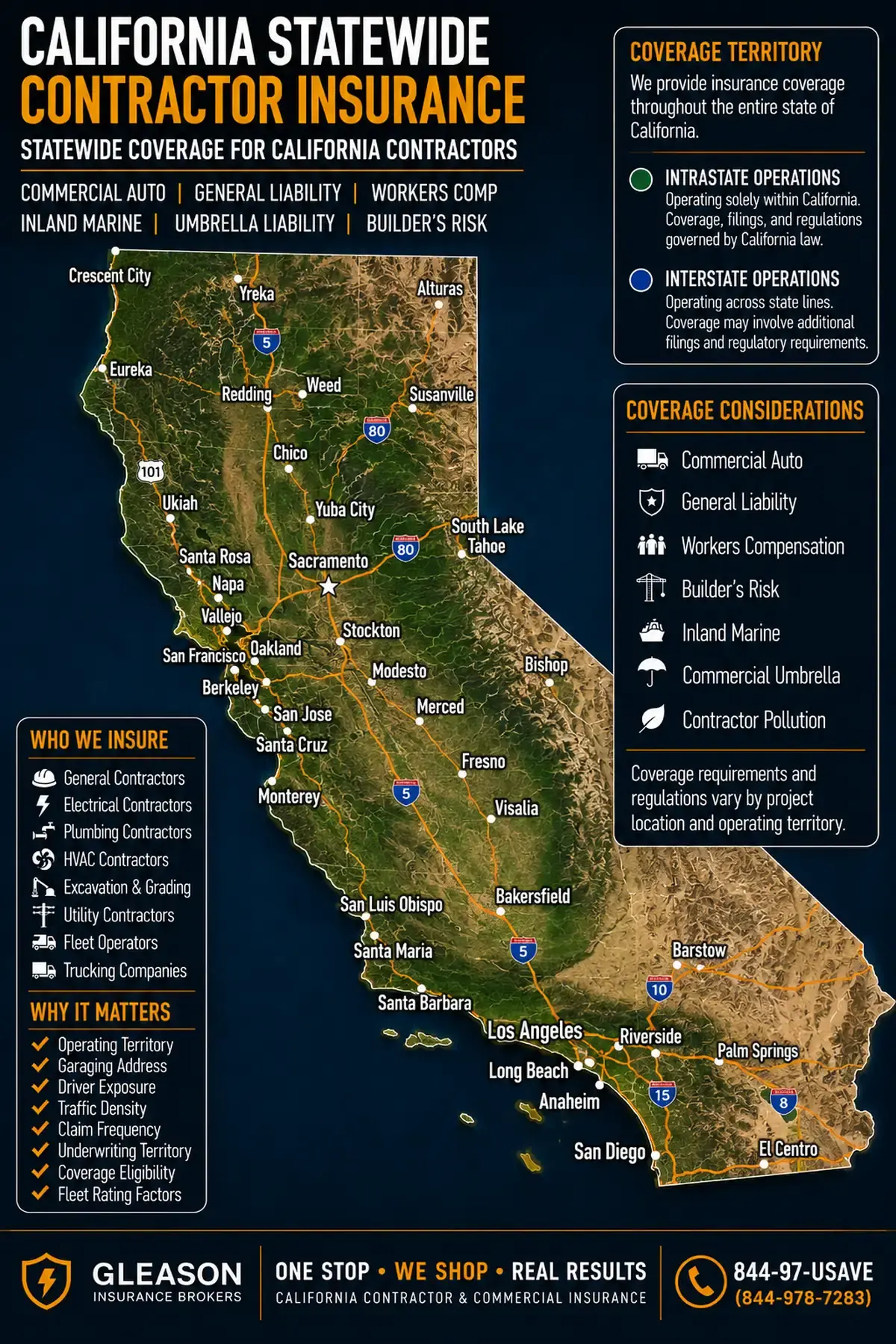
California statewide contractor insurance coverage map showing intrastate and interstate operations from Sacramento to San Diego — Gleason Insurance Brokers

One Stop · We Shop · Real Results

844-978-7283
  • General contractors
  • Electrical contractors
  • Plumbing contractors
  • HVAC contractors
  • Excavation and grading
  • Utility contractors
  • Fleet operators
  • Trucking companies
  • Operating territory
  • Garaging address
  • Driver exposure
  • Traffic density
  • Claim frequency
  • Underwriting territory
  • Coverage eligibility
  • Fleet rating factors
  • Commercial auto
  • General liability
  • Workers compensation
  • Builders risk
  • Inland marine
  • Commercial umbrella
  • Contractor pollution

Radius, territory, vehicle use, jobsite locations and garaging ZIP code can all influence commercial insurance pricing and underwriting eligibility. The zones shown describe how far this agency places coverage; they are not a statement of what any policy covers.

From our case files: a residential policy on a commercial job

A residential-only classification is written for residential work, and a claim from any other kind of job can fall outside it.

Read more

One fencing contractor with that rating accepted a commercial project without calling us first; paint overspray from the job landed on cars at a neighboring business, the claims were denied for lack of a commercial classification, and the owner paid for every vehicle personally (case study 3). If a job falls outside the operations on your application, call before you bid it.

Building your residential program with Gleason Insurance Brokers

We build residential contractor programs around your actual mix of new-build and remodel work, your trade classifications, and your completed-operations exposure — not a generic contractor package that treats every residential job the same way.

Read more

Share your current operations, project types and any recent claims history, and we'll identify what's already well-structured and what needs attention. Call 844-978-7283 or request a quote to start.

We're licensed to write residential contractor coverage beyond California too — see Arizona, Nevada, Texas and Utah if you build or remodel homes across state lines.

Before you request a quote, our pre-project checklist and underwriting readiness guide walk through what a clean residential submission actually needs.

Programs built around your actual new-build vs. remodel mix
Completed operations and mold sublimits reviewed against your real trade exposure
Subcontractor risk transfer support for residential-scale subs
Call 844-978-7283, or submit a quote request to begin

Where residential growth is concentrated in California right now

Residential construction demand isn't spread evenly across California — it's concentrated in a specific set of fast-growing communities, largely in the Central Valley, the Inland Empire and Sacramento-area suburbs, where new subdivisions are adding households faster than almost anywhere else in the state.

Read more

The list below is based on recent population-growth-rate data and reporting on active residential development, not a guess.

These are the cities where a residential contractor is most likely to find sustained new-home demand over the next several years — useful whether you're deciding where to expand crews or just want to know where the work actually is.

Mountain House — one of the fastest-growing communities in the state by percentage growth, San Joaquin County Stockton-area coverage
Lathrop — growth driven almost entirely by River Islands, a nearly 5,000-acre master-planned community Stockton-area coverage
Manteca — roughly 20 subdivisions under construction, including Machado Ranch and Oakwood Trails Coverage in Manteca
Tracy — part of the same San Joaquin County growth corridor as Manteca and Lathrop Coverage in Tracy
Menifee — one of California's most consistently fast-growing cities, Riverside County Coverage in Menifee
Beaumont — among the fastest-growing cities in the state by annual percentage growth Inland Empire coverage
Murrieta — part of southwest Riverside County's ongoing residential growth corridor Coverage in Murrieta
Fontana — active master-planned communities including Arboretum and Summit at Rosena Coverage in Fontana
Lincoln — one of the fastest-growing cities in Placer County Coverage in Lincoln
Roseville — sustained Sacramento-suburb growth, driven partly by relative affordability Coverage in Roseville
Elk Grove — one of the larger, steadily growing Sacramento-area suburbs Coverage in Elk Grove
Folsom — continued Sacramento-region residential expansion Coverage in Folsom
Rancho Cucamonga — steady Inland Empire residential growth alongside its industrial base Coverage in Rancho Cucamonga
Santa Maria — notable ADU and residential permit growth on the Central Coast Coverage in Santa Maria
Madera — Riverstone, one of the fastest-selling master-planned communities in the greater Fresno area Fresno-area coverage
Shafter — one of the faster-growing communities in the greater Bakersfield area Bakersfield-area coverage
Paradise / Chico area — continued residential rebuilding and growth in Butte County Chico-area coverage

Frequently asked questions

10 questions — start typing to filter

Is residential contractor insurance different from a standard contractor GL policy?

It should be structured differently even if it's the same policy type — residential work carries completed-operations and mold/water-intrusion exposure that a generic commercial-focused package may not price or cover accurately.

What is California's Right to Repair Act?

It's a statutory framework (Civil Code section 895 et seq.) that sets construction standards and a pre-litigation process for new residential construction-defect claims — it extends a builder's real exposure well beyond substantial completion.

Does my policy cover mold claims?

Many policies sublimit or exclude mold coverage — confirm the actual language with your broker rather than assuming standard GL coverage applies the way you'd expect, especially if you do roofing, stucco or waterproofing work.

How is a remodeler's risk different from a new-home builder's?

A remodeler works inside an occupied home and takes on existing-condition disputes and occupied-space liability; a new-home builder's risk concentrates in builders risk and completed operations on a structure nobody has lived in yet.

Do I need separate coverage for new-build and remodel work?

Not necessarily separate policies, but both should be accurately classified and reported if you do both — misclassified operations are a common source of coverage gaps at claim time.

How long does completed operations coverage need to last?

Long enough to cover your state's construction-defect statute of limitations and repose periods — a defect surfacing well after the job is finished is common, not unusual, for residential work.

What's the biggest workers' comp consideration for residential crews?

Accurate job-site and classification reporting for crews that move between multiple active homes in a single day, plus a written IIPP that reflects real job-site conditions like fall protection and ladder safety.

Can Gleason help with both my residential and commercial contractor operations?

Yes — if your business does both, see our dedicated Commercial Contractor Insurance page, and we can coordinate both programs together.

Is there a difference between production home builders and custom home builders?

Yes — a production builder repeats the same designs across many lots with tighter cost and schedule margins, while a custom builder works one-off designs with more owner involvement per project. Both carry the same Right to Repair Act completed-operations exposure, but classification and volume should reflect which model you actually run.

Do residential trades like roofing, framing or plumbing need their own policy, or does my GL cover them?

As the residential GC, your own GL, workers comp and umbrella cover your operations; each subcontracted trade — framing, roofing, plumbing, electrical, pool — should carry its own policy, verified through your risk-transfer process rather than assumed under yours.

Areas we serve near Residential Contractor Insurance California

Coverage placed for contractors and businesses operating in Residential Contractor Insurance California and these surrounding communities.

View ZIP codes we serve (33)

Stockton, CA: 95201, 95202, 95203, 95204

Riverside, CA: 92501, 92502, 92503, 92504

Fontana, CA: 92331, 92334, 92335, 92336, 92337

Elk Grove, CA: 95624, 95757, 95758, 95759

Fresno, CA: 93650, 93701, 93702, 93703

Bakersfield, CA: 93301, 93302, 93303, 93304

Irvine, CA: 92602, 92603, 92604, 92606

Sacramento, CA: 94203, 94204, 94205, 94206

Additional official resources

Verify current licensing, regulatory and program requirements directly with the responsible agency — this is general information, not legal advice, requirements change without notice, and what is summarized here may be out of date or contain errors. Confirming what applies to your own city, project, contract and policy is your responsibility.

Explore Related Coverage and Contractor Resources

Related coverage
Guides, trades and resources

Updated October 12, 2026