Gleason Insurance Brokers

General Liability · Workers' Comp · Commercial Auto · Pollution Insurance · Surety Bonds Start a Business Insurance Quote Today

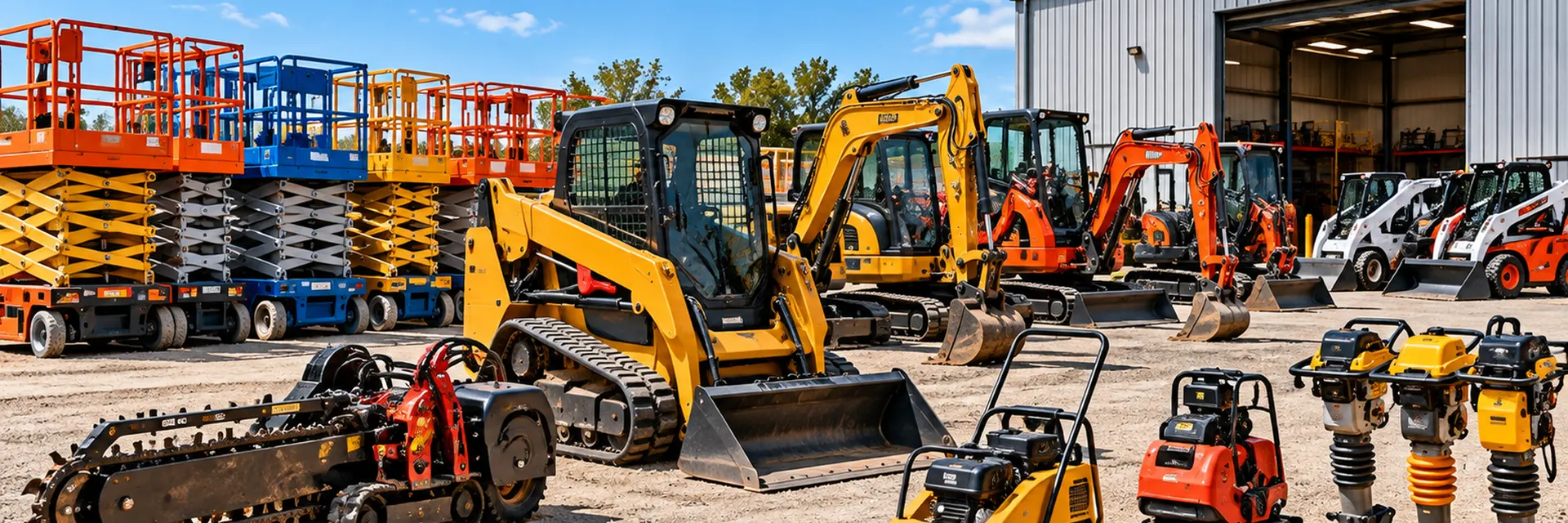
A rental fleet staged outside the shop: scissor lifts in a row, a track loader and mini excavators, with plate compactors, rammers and a trencher out front — construction equipment rental insurance

Equipment rental operations

Construction Equipment Rental Insurance California

844-97-USAVE

A construction-equipment rental company makes money by putting its most valuable assets into somebody else's custody. That single fact should drive the insurance program. For a California rental business producing roughly $5 million to $75 million in annual revenue, the account is no longer a simple "equipment floater plus GL" risk. The broker has to understand rental inventory, contract language, customer screening, delivery operations, shop work, yard concentrations, fraud, lost rental income and the difference between equipment the company rents to others and equipment it temporarily rents from others.

  • Rental Fleet Schedule
  • Rented to Others
  • Newly Acquired Equipment

Reviewed by David Gleason, Principal — October 11, 2026

Next Level Experience. Insurance Done Right.

CaliforniaGeneral information only, not legal advice — illustrative scenarios and coverage, subject to change without notice. Content may be out of date or contain errors, and requirements vary by city, county, state, agency, project, contract, carrier and policy, among other factors; verifying what applies to your own situation is your responsibility. Full disclaimer

Interactive coverage guide

Build a coverage stack around how the business actually operates.

Start with the preselected industry or trade, then adjust the operational questions. The commonly considered stack updates live. Keep the coverages you want GIB to evaluate, remove ones you do not want included in your quote request, and add other available lines before continuing.

Common Starting Coverages

General LiabilityThird-party injury and property damage

What it is

General Liability commonly addresses covered third-party bodily injury, property damage and certain personal or advertising injury claims, subject to the policy.

Why businesses like yours commonly carry it

Businesses commonly use it as a starting liability policy and to satisfy customer, landlord or contract requirements.

Possible coverage gap

General Liability is not intended to replace policies for employee injuries, business vehicles, owned property, cyber events or professional errors.

Learn more about General Liability
Equipment / Inland MarineMobile tools, equipment and property away from premises

What it is

Inland Marine is commonly used for tools, equipment and certain mobile property that moves between locations or jobsites.

Why businesses like yours commonly carry it

Rental businesses may have high-value equipment moving among yards, customers and jobsites.

Possible coverage gap

General Liability should not be assumed to insure the business's own tools and equipment against theft or physical damage.

Learn more about Equipment / Inland Marine

Commonly Added Based on Operations

Business Owners Policy / Commercial PackageLiability and property components evaluated together

What it is

A Business Owners Policy commonly combines liability and property coverages for eligible businesses. A Commercial Package Policy may combine multiple commercial coverage parts depending on the account and carrier.

Why businesses like yours commonly carry it

Businesses with premises, contents, inventory or other property exposures may ask GIB to evaluate whether liability and property components can be packaged where appropriate.

Possible coverage gap

Eligibility, included coverages and package structure vary by carrier. Commercial Property may also be written separately rather than as part of a package.

Learn more about Business Owners Policy / Commercial Package
Cyber Liability & Data BreachCyber events, data and system interruption

What it is

Cyber insurance may address certain first-party and third-party losses from covered data breaches, cyberattacks, ransomware and system interruption, depending on the policy.

Why businesses like yours commonly carry it

Rental operations keep renter identification, card data and telematics on connected systems.

Possible coverage gap

General Liability generally should not be assumed to address data breach response, ransomware or network interruption.

Learn more about cyber insurance for smaller equipment businesses

Exposure-Dependent Coverages

Commercial AutoBusiness vehicles, drivers and physical damage

What it is

Commercial Auto may address liability arising from covered business vehicles and, when selected, physical damage and other vehicle-related coverages.

Why businesses like yours commonly carry it

Businesses that own or regularly use vehicles may need a policy structured around business use, drivers and vehicle schedules.

Possible coverage gap

Personal auto policies may restrict or exclude business use, and General Liability is generally not a substitute for auto liability.

Learn more about Commercial Auto
Umbrella / Excess LiabilityAdditional limits above scheduled liability policies

What it is

Umbrella or Excess Liability may provide additional limits above identified underlying liability policies, subject to its own terms and exclusions.

Why businesses like yours commonly carry it

Businesses with larger contracts, vehicles, public exposure or higher severity potential commonly consider additional limits.

Possible coverage gap

An umbrella does not automatically broaden every exclusion or sit over every policy unless the issued terms say it does.

Learn more about Umbrella / Excess Liability

Loading quote and requirements options…

Educational guidance only. Results are not a coverage recommendation, quote, binder, policy interpretation, or guarantee of coverage. Actual needs, availability, forms, limits, exclusions and requirements vary. A licensed insurance professional should review the complete risk and issued policy terms.

Verified Google reviews

What contractors say about us

5.0 / 5from 7 Google reviews

Reviews reflect individual client experiences and are not a guarantee of coverage, pricing or results.

91 Enterprise LLC

91 Enterprise LLC

March 24, 2026

We are using Gleason insurance for our commercial auto policy and GL policy. David is the best insurance broker I've worked with — very honest, responsive, and knowledgeable. Highly recommend.

Fito Plumbers

Fito Plumbers

February 20, 2026

We have been working with David at Gleason Insurance Brokers for 8+ years. David always goes above and beyond to make sure we have the appropriate coverages. He explains everything in detail and makes sure we feel confident and understand all of our policies. He is always available and responds right away!

Barry Stay

Barry Stay

February 17, 2026

David provides great service and I highly recommend him for your insurance needs.

The Rental Fleet Is the Balance Sheet

A serious underwriting submission should split the fleet by class and maximum value: excavators, loaders, dozers, compact equipment, lifts, forklifts, trenchers, generators, compressors, pumps, scaffolding, trailers, trade-specific tools and attachments.

Read more

The schedule should also identify newly acquired equipment and units financed or leased.

The key figures are not just total fleet value. Underwriters care about the largest single item, maximum value at one customer location, concentration at one yard, amount in transit and how often the fleet turns over. Rental fleets that also sell new and used units pick up dealer exposures, explained on insurance for construction equipment dealers.

The schedule should also identify newly acquired equipment and units financed or leased
The key figures are not just total fleet value

Rented-to-Others Must Be Explicit

A contractor-equipment policy written for a contractor's own machinery is not automatically the right form for inventory intentionally rented to customers.

Read more

The policy should contemplate property held for rental and equipment while in a renter's care, custody and control.

Coverage questions include theft, fraudulent rental, conversion, subrenting, operator abuse, prohibited use, transit, continuing rental charges, loss of rental income and what happens when a machine is recovered damaged after being missing.

The distinction that causes the most trouble is between equipment a business owns and uses, and equipment it owns and rents out for someone else to operate. Many contractor's equipment forms are written around the first case. A rental company's entire business model is the second, and a form that does not say so explicitly can leave the fleet's working life — the period when it is in a customer's custody, on a site the rental company has never seen, operated by someone it has not trained — as the least clearly covered part of the schedule.

Reading for it is specific work. Whether rented-to-others is named, whether it is sublimited below the fleet limit, whether coverage continues while the unit is in transit to and from the customer, and whether it applies when the customer re-rents to a third party are four separate questions with four separate answers. A certificate from the customer does not resolve any of them, because it evidences the customer's policy rather than the terms of the rental company's own. Smaller rental counters focused on hand tools, compaction and light equipment are covered on contractor tool and equipment rental insurance.

A contractor-equipment policy written for a contractor's own machinery is not automatically the right form for inventory intentionally rented to customers
The policy should contemplate property held for rental and equipment while in a renter's care, custody and control

Rental Agreements Are a Risk-Transfer Tool

The rental contract should be reviewed with counsel for damage responsibility, loss of use, theft, fuel contamination, transport, operator restrictions, underground work, waterborne work, indemnity, customer insurance, damage waiver, subrenting and recovery costs.

Read more

A COI process is useful only when it matches the obligations created by the contract. How damage waivers, certificates and additional insured requests should line up with your agreement is covered in equipment rental agreements and insurance risk transfer.

A COI process is useful only when it matches the obligations created by the contract

How risk transfer works in a rental agreement

Equipment Rental Company → Renter → The Jobsite It Goes To

A rental agreement moves risk before the equipment leaves the yard, and the machine then sits on a site governed by contracts the rental company never signed. Open a handoff to see what commonly travels with it.

Equipment Rental Company
  • The rental agreement itselfThe contract doing the work here, and not a subcontract. It commonly sets who bears physical damage, who carries liability while the machine is in use, what happens if it is stolen, and what is owed for the time it cannot be re-rented. Those terms generally govern regardless of what either party’s policy says, which is why reading it first tends to be the useful order.
  • A damage waiver is not insuranceA waiver is the rental company agreeing, by contract, to limit what it will pursue the renter for. It is not a policy, there is no insurer behind it, and it commonly carries exclusions — overturn, misuse, operating outside the manufacturer’s specifications, theft without signs of forced entry, and unattended equipment are frequently among them. A renter who declines it is not uninsured, and a renter who accepts it is not fully covered.
  • Rented or leased equipment coverageThe renter’s own inland marine cover for equipment in its care. The limit has to reach the largest single unit on rent, not the average one, and a contract that names a flat figure may sit well below the machine actually being collected.
  • The rental company named on the renter’s policyCommonly as loss payee on the equipment cover and as an additional insured on the liability side for operations involving the machine. These are two different things on two different policies, and a certificate showing one is not evidence of the other.
  • Waiver of subrogationCG 24 04Gives up the insurer’s right to recover from the upstream party after paying a claim. Frequently named alongside additional insured status rather than instead of it.
  • Certificate, plus the endorsements behind itA certificate evidences that a policy existed on the day it was issued. It is not proof that any particular endorsement sits on that policy, which is why a requirement is commonly checked against the endorsement itself.

Collected once at account opening and never again is the common failure. A rental relationship frequently outlives the policy term that was evidenced when it started.

Renter — the contractor or business renting
The Jobsite, and whoever controls it

The limits a contract asks for, and what each one means

Rental agreements and the contracts on the sites equipment goes to both commonly state limits. One million dollars per occurrence with a two million dollar general aggregate is a combination many of these agreements use, but for a rental account the equipment limit is frequently the number that decides whether a loss is made whole, and it varies by fleet rather than by contract.

Per occurrence
The most the policy generally pays for any one covered occurrence.
Rented or leased equipment limit
Needs to reach the largest single unit on rent rather than a typical one. A fleet average is a common way to end up short on exactly the machine that was damaged.
General aggregate
The most the policy generally pays across the term, covering the yard and the operation as well as the equipment in the field.
Auto liability for delivery and pickup
A rental company that delivers is running a fleet business alongside a rental one, and it is commonly the higher-frequency half of the account.
Umbrella or excess above it
Sits above the underlying limits. What it sits over matters as much as how high it reaches, since a tower built only over general liability leaves the fleet and the equipment short of what an agreement may assume.

Delivery Fleet and Loading Exposure

Middle-market rental companies often operate pickups, stake beds, rollback trucks, tractors, lowboys and trailers.

Read more

Commercial auto underwriting should address drivers, radius, DOT exposure where applicable, backing at jobsites, load securement, towing, hired/non-owned auto and physical damage.

A loss can involve both the delivery unit and the rented equipment, so auto and inland marine should be coordinated.

Middle-market rental companies often operate pickups, stake beds, rollback trucks, tractors, lowboys and trailers
A loss can involve both the delivery unit and the rented equipment, so auto and inland marine should be coordinated

GL, Products and Maintenance Allegations

A renter injured while using a machine may allege poor maintenance, negligent inspection, inadequate warning, incorrect setup or unsafe accessories.

Read more

General liability should match the actual rental operation, and the company should maintain inspection, maintenance and condition records.

A renter injured while using a machine may allege poor maintenance, negligent inspection, inadequate warning, incorrect setup or unsafe accessories
General liability should match the actual rental operation, and the company should maintain inspection, maintenance and condition records

Yard Property and Business Interruption

Rental yards can concentrate millions of dollars of equipment, parts, shop machinery, tires, fuel and office property behind one fence.

Read more

Property coverage should address outdoor inventory, wildfire, flood, theft, fire protection, shop values and business income.

Rental yards can concentrate millions of dollars of equipment, parts, shop machinery, tires, fuel and office property behind one fence
Property coverage should address outdoor inventory, wildfire, flood, theft, fire protection, shop values and business income

Breakdown Is Not the Same as Accidental Damage

A machine struck during transport presents a different claim from an engine, generator or pump suffering internal mechanical or electrical failure.

Read more

Equipment-breakdown coverage may be relevant to certain rental classes and shop machinery.

Mechanical and electrical breakdown is excluded by many property and equipment forms for a reason that is easy to state and easy to forget: an insurer is covering fortuitous damage, not the wearing out of a machine that is being used as intended. A hydraulic pump that fails from internal wear is a maintenance cost. The same pump failing because a customer ran it dry may be a different question, and the answer usually turns on evidence rather than on the policy wording alone.

That is why maintenance records carry weight out of proportion to their length. A documented service interval per unit, hour-meter readings captured at check-in and check-out, and a record of what was found on return establish whether a failure is wear or abuse. Without them, a claim that is genuinely abuse looks like wear, and the exclusion does the work. Where separate breakdown coverage is available it is commonly written on its own terms with its own deductible, and whether it can be placed depends on the fleet, the records and the carrier.

A machine struck during transport presents a different claim from an engine, generator or pump suffering internal mechanical or electrical failure
Equipment-breakdown coverage may be relevant to certain rental classes and shop machinery

Fraud, Conversion and Crime

Rental businesses deliberately release valuable assets to customers.

Read more

A fake identity, fraudulent business, forged payment or employee theft can create loss that does not fit ordinary theft language. Commercial crime, computer fraud, social engineering and conversion treatment should be reviewed deliberately.

A rental business faces a loss type most contractors never meet: the customer who rents legitimately and simply does not return the machine. That is conversion rather than theft, the distinction is not academic, and it decides which part of the program responds. Many property forms contemplate theft by a stranger; a unit handed over willingly under a signed contract and then kept is a different event, and some forms address it only where voluntary parting is specifically covered.

The controls commonly looked for here are mostly front-desk rather than yard: identity and license verification at contract, a credit or deposit step scaled to unit value, telematics on the higher-value fleet, and a defined escalation point at which an overdue unit stops being a collections matter and becomes a reported loss. A business that escalates at a documented threshold presents a very different file from one that discovers a six-month-old conversion during an annual count.

Rental businesses deliberately release valuable assets to customers
A fake identity, fraudulent business, forged payment or employee theft can create loss that does not fit ordinary theft language
Commercial crime, computer fraud, social engineering and conversion treatment should be reviewed deliberately

Workers Compensation and Field Operations

Mechanics, drivers, yard employees and setup crews create materially different WC exposures from counter staff.

Read more

Payroll should be allocated accurately, especially if employees operate equipment, erect scaffolding or enter active projects.

Mechanics, drivers, yard employees and setup crews create materially different WC exposures from counter staff
Payroll should be allocated accurately, especially if employees operate equipment, erect scaffolding or enter active projects

Excess Liability for Commercial Accounts

Larger customers, public works contractors and project owners can require higher limits.

Read more

Umbrella/excess should be considered over GL, auto and employers liability based on fleet severity, equipment class and customer contracts.

Larger customers, public works contractors and project owners can require higher limits
Umbrella/excess should be considered over GL, auto and employers liability based on fleet severity, equipment class and customer contracts

Lines we place for equipment rental and dealers

A rental yard or dealership rents and sells to the trades rather than performing the work, and its program reflects that.

Read more

The fleet or inventory is the balance sheet, and the rental agreement is doing as much risk transfer as any policy. These are the lines that come up most often. What applies depends on the fleet, the agreement in use and each carrier’s appetite at the time.

Send the fleet or inventory schedule, your rental agreement and any current loss information — request a rental or dealer quote. Coverage is not bound by submitting a request. Your customers carry their own coverage for machines they rent from you, described on contractor coverage for rented equipment, and the rental agreement decides how much of a loss falls on them.

Rented-to-others — needs to be explicit for machines in a customer’s possession, and is commonly where a program is found short
Inland marine on the fleet or inventory — the machines themselves, on the yard, in transit and on hire
General liability and products — including allegations about maintenance, condition or instruction at handover
Yard property and business interruption — the premises, the shop and the earnings lost while either is out of use
Delivery fleet — haul trucks, trailers and the loading and unloading exposure
Workers compensation — yard, mechanic, driver and field-service classifications
Excess liability — commonly required by commercial accounts and national customers
Crime and cyber — conversion and fraudulent rental are a real exposure for a yard, alongside the systems holding customer accounts

Underwriting File for a $5M-$75M Rental Company

Prepare revenue by rental class, fleet values, largest unit, equipment schedule, yard values, delivery fleet, customer pickup percentage, rental agreement, damage waiver, GPS/telematics, maintenance controls, customer screening, driver list, locations and five years of losses.

revenue by rental class
fleet values
largest unit
equipment schedule
yard values
delivery fleet
customer pickup percentage
rental agreement

Frequently asked questions

11 questions — start typing to filter

What insurance does a construction equipment rental business typically need?

A program may include rented-to-others inland marine, property, GL, auto, workers compensation, equipment breakdown, crime and umbrella/excess.

Does a normal contractor equipment policy automatically cover equipment rented to customers?

No. The form should specifically contemplate equipment held for rental or rented to others.

What if a customer never returns a machine?

Theft, fraud and conversion may be treated differently, so policy language and the facts of the transaction matter.

Does GL pay for damage to the rental fleet?

Usually GL is not the property coverage for the fleet. Physical loss is generally addressed through equipment/inland marine coverage.

Can lost rental income be insured?

Some programs can provide time-element or rental-income coverage after a covered loss, but it should be confirmed rather than assumed.

Should rental businesses require customer COIs?

That can be useful for larger commercial renters when the requirement is tied to the rental contract and actual risk transfer.

How often should equipment values be updated?

At least annually and whenever significant acquisitions, disposals or market-value changes occur.

Do larger rental companies need excess liability?

Often yes because heavy equipment, delivery fleets and commercial contracts can create severe third-party claims.

Our form covers contractor's equipment. Is rented-to-others included?

It has to be read for specifically, because many contractor's equipment forms are written around equipment the insured owns and uses rather than equipment it rents out. Four separate questions are worth answering: whether rented-to-others is named at all, whether it is sublimited below the fleet limit, whether it continues while a unit is in transit to and from the customer, and whether it applies if the customer re-rents to a third party. A certificate from the customer resolves none of them, because it evidences their policy rather than the terms of yours.

Why is mechanical breakdown excluded when the machine is clearly damaged?

Because an insurer is covering fortuitous damage rather than a machine wearing out in normal use. A hydraulic pump that fails from internal wear is a maintenance cost; the same pump failing because a customer ran it dry may be a different question, and the answer usually turns on evidence. Service intervals per unit, hour-meter readings at check-in and check-out, and a record of what was found on return are what establish wear against abuse. Separate breakdown coverage, where it can be placed, comes with its own terms and deductible.

A customer rented a machine and never brought it back. Is that theft?

Usually it is conversion rather than theft, and the distinction decides which part of the program responds. Many property forms contemplate theft by a stranger, while a unit handed over willingly under a signed contract and then kept is a different event that some forms address only where voluntary parting is specifically covered. The controls that matter here are front-desk rather than yard: identity and license verification at contract, a deposit step scaled to unit value, telematics on higher-value units, and a documented point at which an overdue unit stops being a collections matter and becomes a reported loss.

Official resources

Verify current licensing, regulatory and program requirements directly with the responsible agency — this is general information, not legal advice, requirements change without notice, and what is summarized here may be out of date or contain errors. Confirming what applies to your own city, project, contract and policy is your responsibility.

Updated October 11, 2026