
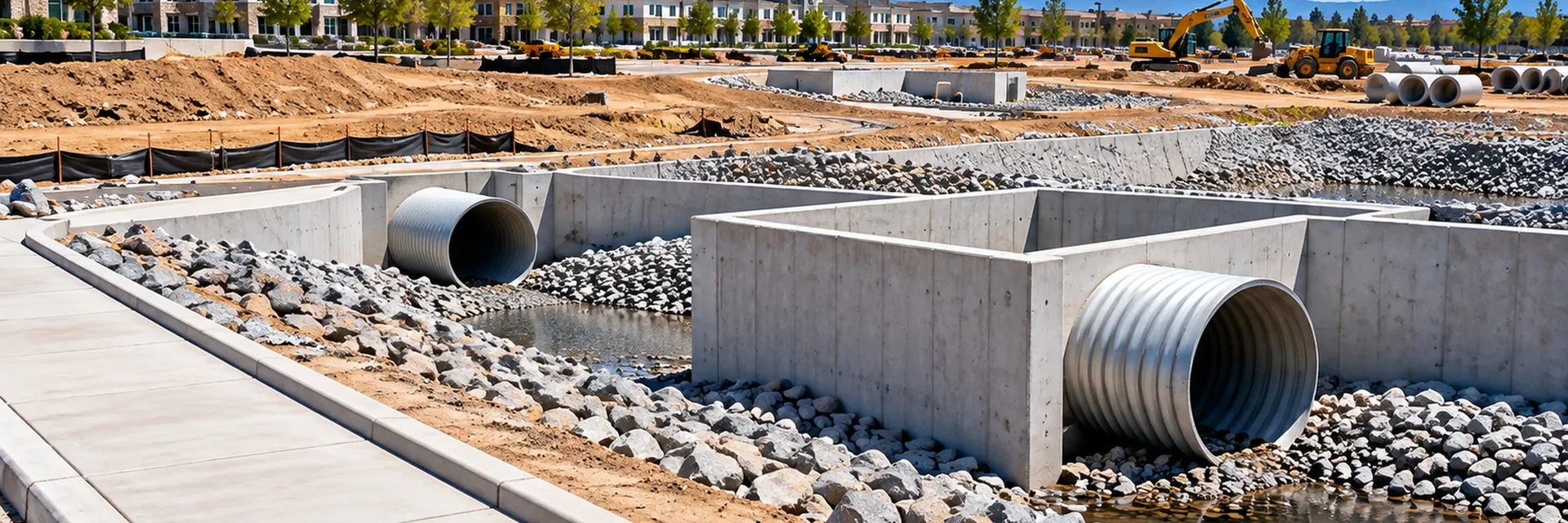


Stormwater
Hydrology, detention, conveyance and grading assumptions can be challenged after major storms.
Pump Stations
Mechanical systems, controls and redundancy can produce operational-loss allegations.
Showing 1 of 4
Water / Wastewater
Public projects often combine environmental obligations with demanding contracts.
Design Criteria
Document rainfall assumptions, design criteria and owner requirements clearly.
Middle-market risk profile
Water and drainage practices need to be separated into land-development drainage, municipal stormwater, water distribution, wastewater, pump stations, flood-control and process work. Those specialties create very different severity and regulatory exposure.
Contract and scope review
The agreement should document design criteria, rainfall/hydrology assumptions, owner data, capacity requirements, permitting responsibility and the line between design and operational performance guarantees.
What underwriters should receive
Show revenue by stormwater/water/wastewater, municipal percentage, pump-station work, treatment systems, flood-control, largest project, design-build, field commissioning, cyber access to utility systems and claims.
Three claim scenarios to model
Scenarios worth modeling before marketing or binding this account:
Program structure beyond E&O
Professional liability should coordinate with pollution coverage where wastewater or environmental services are involved. Cyber becomes more important when the firm accesses SCADA, municipal or utility systems.
Large-firm underwriting questions
For a larger water/drainage practice, these answers show the balance between land-development drainage, municipal systems, wastewater and pump-station work and help size both professional and pollution protection.
Operational and public-entity complexity
Water-focused firms can cross from traditional civil design into process, mechanical, controls and environmental work. That can create coverage overlap between professional liability, pollution and cyber, especially where engineers access municipal control systems or commission equipment. The broker should identify whether the firm merely designs infrastructure or also provides startup, operations support, compliance consulting or emergency services. Those distinctions can materially affect both carrier selection and required limits.
Frequently asked questions
8 questions — start typing to filter
Can drainage claims arise years later?
Yes — like other civil and drainage work, a design's real-world performance during storm events may not be tested for years, so continuous coverage matters more than it would for a shorter-tail professional service.
Does PL cover flood allegations?
Potentially if professional negligence is alleged.
Are utility projects higher risk?
They can be — utility coordination work involves both underground unknowns and third-party utility-owned infrastructure, raising both professional liability and property-damage severity.
Is pollution insurance relevant?
Often for wastewater or environmental work.
Does cyber matter?
It can when firms access municipal or utility systems.
Should pump-station work be disclosed?
Yes. Pump-station and lift-station design carries mechanical and electrical coordination exposure that should be described specifically in the submission, not folded generically into 'civil engineering.'
Show 2 more questions
Does FEMA floodplain work carry added exposure?
Yes — floodplain and drainage work tied to FEMA mapping or compliance carries regulatory scrutiny and public-safety consequences beyond a typical private drainage design.
What happens when a drainage design relied on rainfall data that has since been revised?
This is one of the recurring arguments in drainage claims, and it usually turns on what was reasonable at the time rather than on what is known now. Intensity-duration-frequency data, county hydrology manuals and FEMA mapping are all periodically updated, and a system sized correctly against the published figures of its day can be undersized against the current ones. The standard a professional liability claim is generally measured against is the care ordinarily exercised by comparable practitioners at the time the work was performed, which is why firms commonly record the data source, edition and date in the calculations themselves. It is a documentation habit rather than a coverage feature, and it is frequently what the file turns on.
California · General information only, not legal advice. Requirements vary by city, county, state, agency, project, contract, carrier and policy, among other factors; verifying what applies to your own situation is your responsibility. Full disclaimer
Reviewed by David Gleason, Principal — November 2, 2026