Gleason Insurance Brokers

General Liability · Workers' Comp · Commercial Auto · Pollution Insurance · Surety Bonds Start a Business Insurance Quote Today

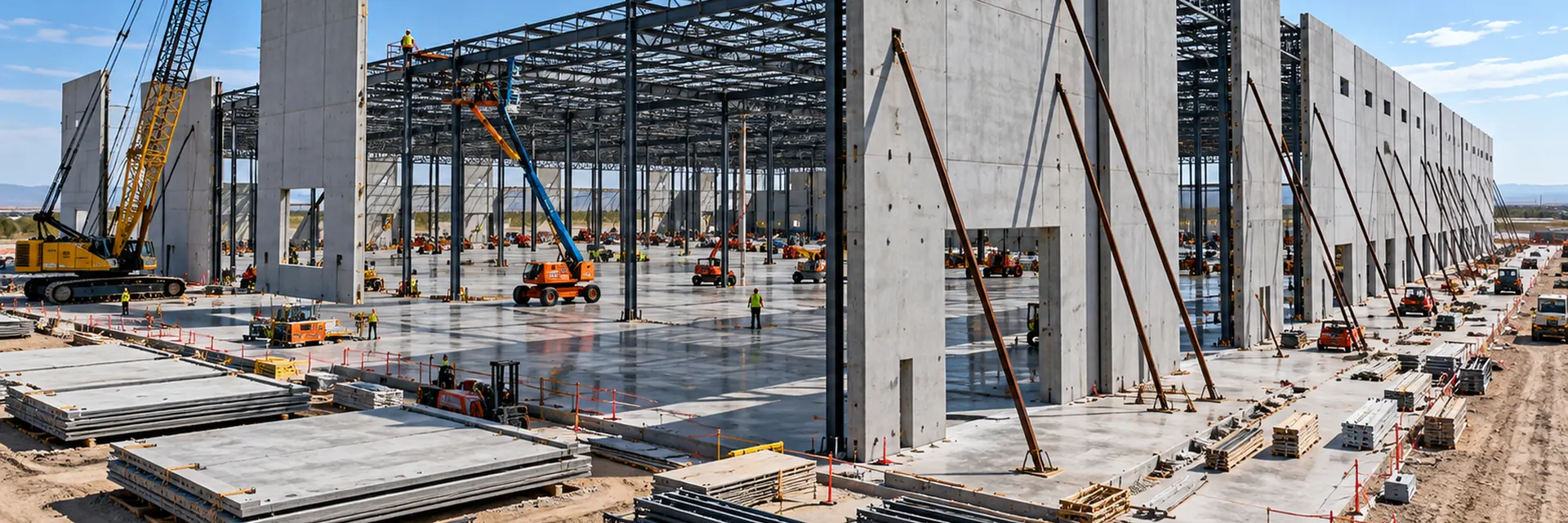
A tilt-up industrial building under construction: a crawler crane setting a concrete wall panel, braced panels along the elevation, long-span steel joists over a finished slab — industrial and

California commercial insurance

Industrial Contractor Insurance California

844-97-USAVE

Industrial and warehouse work concentrates enormous value into a single structure, and the exposures that decide these jobs — tilt-up bracing before permanent connection, racking and conveyor fit-out, refrigeration, high-pile storage fire protection — barely appear on a commercial office project at all.

  • Tilt-Up & High-Value Builders Risk
  • Racking & Installation Floater
  • Umbrella Limits

Reviewed by David Gleason, Principal — October 8, 2026

Next Level Experience. Insurance Done Right.

CaliforniaGeneral information only, not legal advice — illustrative scenarios and coverage, subject to change without notice. Content may be out of date or contain errors, and requirements vary by city, county, state, agency, project, contract, carrier and policy, among other factors; verifying what applies to your own situation is your responsibility. Full disclaimer

Interactive coverage guide

Build a coverage stack around how the business actually operates.

Start with the preselected industry or trade, then adjust the operational questions. The commonly considered stack updates live. Keep the coverages you want GIB to evaluate, remove ones you do not want included in your quote request, and add other available lines before continuing.

Common Starting Coverages

General LiabilityThird-party injury and property damage

What it is

General Liability commonly addresses covered third-party bodily injury, property damage and certain personal or advertising injury claims, subject to the policy.

Why businesses like yours commonly carry it

Businesses commonly use it as a starting liability policy and to satisfy customer, landlord or contract requirements.

Possible coverage gap

General Liability is not intended to replace policies for employee injuries, business vehicles, owned property, cyber events or professional errors.

Learn more about General Liability

Commonly Added Based on Operations

Contractor Equipment / Inland MarineMobile tools, equipment and property away from premises

What it is

Inland Marine is commonly used for tools, equipment and certain mobile property that moves between locations or jobsites.

Why businesses like yours commonly carry it

Contractors frequently move tools, testing equipment and mobile machinery among jobsites.

Possible coverage gap

General Liability should not be assumed to insure the business's own tools and equipment against theft or physical damage.

Learn more about Contractor Equipment / Inland Marine
Cyber Liability & Data BreachCyber events, data and system interruption

What it is

Cyber insurance may address certain first-party and third-party losses from covered data breaches, cyberattacks, ransomware and system interruption, depending on the policy.

Why businesses like yours commonly carry it

Contractors commonly use email, electronic banking, project platforms, payroll systems and cloud document storage.

Possible coverage gap

General Liability generally should not be assumed to address data breach response, ransomware or network interruption.

Learn more about cyber insurance for contractors

Exposure-Dependent Coverages

Installation FloaterMaterials awaiting or undergoing installation

What it is

An Installation Floater may cover certain materials and equipment in transit, temporary storage and during installation, subject to the policy.

Why businesses like yours commonly carry it

Businesses responsible for materials before final installation commonly consider this coverage.

Possible coverage gap

A basic liability policy generally should not be assumed to cover the insured's materials against physical loss before installation is complete.

Learn more about Installation Floater
Builder's RiskProject property during construction

What it is

Builder's Risk may insure covered buildings, materials and certain project property while construction is underway.

Why businesses like yours commonly carry it

Owners, developers and contractors commonly consider it when a structure or major renovation is exposed during construction.

Possible coverage gap

Commercial Property and General Liability are not automatic substitutes for course-of-construction property coverage.

Learn more about Builder's Risk
Contractors Pollution LiabilityPollution conditions and cleanup liability

What it is

Pollution Liability may address covered cleanup costs and third-party injury or property damage arising from pollution conditions.

Why businesses like yours commonly carry it

Businesses working with fuels, chemicals, soil, water, demolition or environmental conditions may have pollution exposures.

Possible coverage gap

Standard General Liability commonly contains pollution exclusions or limitations.

Learn more about Contractors Pollution Liability
Umbrella / Excess LiabilityAdditional limits above scheduled liability policies

What it is

Umbrella or Excess Liability may provide additional limits above identified underlying liability policies, subject to its own terms and exclusions.

Why businesses like yours commonly carry it

Businesses with larger contracts, vehicles, public exposure or higher severity potential commonly consider additional limits.

Possible coverage gap

An umbrella does not automatically broaden every exclusion or sit over every policy unless the issued terms say it does.

Learn more about Umbrella / Excess Liability

Loading quote and requirements options…

Educational guidance only. Results are not a coverage recommendation, quote, binder, policy interpretation, or guarantee of coverage. Actual needs, availability, forms, limits, exclusions and requirements vary. A licensed insurance professional should review the complete risk and issued policy terms.

Verified Google reviews

What contractors say about us

5.0 / 5from 7 Google reviews

Reviews reflect individual client experiences and are not a guarantee of coverage, pricing or results.

91 Enterprise LLC

91 Enterprise LLC

March 24, 2026

We are using Gleason insurance for our commercial auto policy and GL policy. David is the best insurance broker I've worked with — very honest, responsive, and knowledgeable. Highly recommend.

Fito Plumbers

Fito Plumbers

February 20, 2026

We have been working with David at Gleason Insurance Brokers for 8+ years. David always goes above and beyond to make sure we have the appropriate coverages. He explains everything in detail and makes sure we feel confident and understand all of our policies. He is always available and responds right away!

Barry Stay

Barry Stay

February 17, 2026

David provides great service and I highly recommend him for your insurance needs.

What makes an industrial job a different underwriting conversation

Industrial and warehouse projects concentrate value in a way almost nothing else in construction does.

Read more

A single distribution building can carry more insured value under one roof than a whole subdivision spread across forty lots, and that one number drives the builders risk limit, the deductible structure and which carriers will look at the job at all. On residential work the conversation is about how many projects are open at once; here it is usually about how much sits in one place.

Scale changes the people exposure too. Large open slabs, long-span steel, heavy equipment in continuous motion and a schedule compressed by a tenant's move-in date put more trades on top of each other than a comparable commercial office build. Underwriters tend to read an industrial submission for how the work is sequenced as much as for what it is worth.

One structure, one insured value — builders risk appetite is driven by the single largest project, not the average
Long-span steel and large open slabs put more trades in the same space at the same time
Tenant move-in dates compress schedules in a way that shows up in the loss record
Site work and the building are often bid and insured on different timelines

Tilt-up concrete and the window before permanent connection

A great deal of California's industrial product is tilt-up: panels cast flat on the slab, lifted by crane and braced upright until the roof structure ties them in permanently.

Read more

That period between the lift and the permanent connection is short, and it is where much of the catastrophic potential on these jobs sits. Temporary bracing is temporary work, and temporary work is commonly sub-limited or treated differently from permanent construction rather than covered outright — what applies to any one project depends on the policy as issued.

Underwriters reviewing tilt-up work generally want to know who engineered the bracing, who is responsible for removing it and when, what the lift plan says, and which subcontractor supplies the crane and rigging. Those answers tend to matter more to a decision than the contract value does.

The braced-but-unconnected period is the exposure, not the lift itself
Bracing design and removal are commonly a named responsibility in the subcontract
Crane and rigging are frequently subcontracted, which raises the contractual risk-transfer question
Confirm how temporary works are treated in the builders risk policy as issued, not in general

Racking, conveyors and the fit-out that follows the shell

Industrial work rarely ends at the shell.

Read more

Storage racking, conveyor lines, mezzanines, dock equipment and automation arrive afterwards, often under separate contracts and sometimes from the tenant rather than the owner. The value of that equipment can rival the building, and it spends a meaningful period on site installed but not yet accepted.

That is an inland marine conversation more than a property one. Materials in transit, materials staged on site and materials installed but not yet turned over are three different states, and a program that only answers for one of them leaves the others open. See installation floater and materials in transit coverage and contractor equipment and inland marine for how those pieces commonly fit together.

Racking and conveyor packages can approach the value of the shell they sit in
In transit, staged on site and installed-not-accepted are three distinct exposures
Tenant-supplied equipment raises a question about who insures it and when
Acceptance and turnover dates decide when the risk moves, so they belong in the file

Cold storage and refrigeration change the conversation again

Cold storage and food distribution buildings add a system the rest of industrial work does not have.

Read more

Refrigeration using anhydrous ammonia introduces a release exposure that general liability policies commonly address narrowly or exclude, which is why contractors pollution liability tends to come up on these projects and rarely on a dry warehouse.

The mechanical scope is also heavier and more specialized than a comparable building of the same footprint, so the trade mix on site skews toward HVAC, mechanical and refrigeration contractors and the sequencing questions underwriters ask follow that.

Ammonia refrigeration raises a release exposure that a general liability policy may not answer for
Commissioning and start-up are commonly where a refrigeration loss tends to occur
Specialized mechanical trades change the subcontractor risk-transfer picture
Process safety documentation is frequently requested during underwriting

Fire protection, high-pile storage and what the building is allowed to hold

What a finished industrial building is permitted to store is tied to the fire protection designed into it.

Read more

High-pile storage changes sprinkler design, and the system a distribution tenant needs is not the system a light manufacturing tenant needs. That matters to the contractor because a late change in the tenant's storage plan can mean reworking a system that is already installed.

Design responsibility is the part worth settling in writing. Where a fire sprinkler contractor carries design-build responsibility rather than installing to someone else's drawings, the exposure shifts toward professional liability, and the requirements themselves are set by the authority having jurisdiction rather than by a single statewide rule — confirm them with that office for the specific project.

Sprinkler design follows the intended storage, which the tenant can change late
Design-build fire protection shifts part of the exposure toward professional liability
Requirements come from the authority having jurisdiction and vary by project
Rework after a storage-plan change is a schedule and a coverage question at once

Power, switchgear and the service a large building needs

Industrial buildings pull serious power, and the electrical scope on a distribution or manufacturing project is closer to infrastructure work than to commercial tenant work.

Read more

Service entrances, switchgear, transformer pads and the coordination with the serving utility all sit on the critical path, and energized work during cutover is among the more serious exposures an electrical contractor carries.

At the upper end this converges with data center construction, where the electrical and mechanical scopes dominate the project. The underwriting conversation there is a different one again, but the exposures begin on the same ground.

Service and switchgear scopes sit on the critical path, which concentrates schedule pressure
Utility coordination introduces a party the contract usually cannot control
Energized cutover work is a named concern in most industrial submissions
Standby and backup power scopes extend the commissioning period

The coverage lines an industrial program commonly carries

The shape of a program for this work is familiar but the proportions are different.

Read more

General liability and workers compensation anchor it; builders risk carries more weight than on almost any other project type because of the single-structure value; inland marine answers for equipment and installed materials; and umbrella or excess limits are usually driven by what the owner's contract requires rather than by what the contractor would choose. On larger projects an owner-controlled or contractor-controlled wrap-up may cover enrolled parties for the site, which changes what the contractor's own policies are doing.

Contract-required limits on industrial work commonly begin at $1 million per occurrence with a $2 million aggregate and are layered upward with umbrella or excess limits, frequently to $5 million or more on larger distribution projects. Those are figures seen in contract requirements rather than figures we are advising anyone to carry.

General information only, not legal advice — illustrative figures and coverage descriptions, subject to change without notice. Coverage terms, availability and requirements vary by carrier, policy, contract, project and jurisdiction; confirm what applies to your own situation against your issued policy and the actual contract documents, and seek legal counsel where the question is a contractual one.

General liability and workers compensation anchor the program
Builders risk carries unusual weight because the value sits in one structure
Inland marine answers for equipment, materials in transit and installed-not-accepted work
Umbrella and excess limits are commonly set by the owner's contract, not by preference
A wrap-up on the project changes what the contractor's own policies are doing

Bonding on industrial projects

Private industrial development is bonded less uniformly than public work, but developer-financed and lender-financed projects frequently call for performance and payment bonds at the general contractor level and sometimes below it.

Read more

A bond is a three-party guarantee rather than insurance — the surety can seek reimbursement from the contractor after a paid claim — and the underwriting leans on financial strength and completed-project history rather than on loss experience.

Single-job capacity matters here more than it does on most work, because one industrial building can be larger than everything else a contractor has open. Performance and payment bonds and the broader contractor bonding picture are covered separately, and bonding and the insurance program can be arranged with one agency rather than split across two.

A bond is a guarantee, not insurance — reimbursement is commonly expected after a paid claim
Single-job capacity is the binding constraint when one building dwarfs the backlog
Lender and developer requirements vary; read the actual contract rather than assuming
Bonding and insurance can be arranged with one agency

A realistic scenario: bracing released before the deck is complete

A tilt-up distribution building is topping out.

Read more

The panels are up and braced, the joists are set across most of the structure, and the roofing subcontractor is pushing to start on the completed half. Someone releases bracing on a run of panels where the deck is attached but the diaphragm is not complete, a weather front moves through overnight, and two panels go over — taking joists, a section of deck and a scissor lift with them.

The questions that follow are not really about the wind. Who engineered the bracing and who was authorized to release it; whether the builders risk policy as issued treats a braced-but-unconnected panel as covered permanent work or as temporary works; whether the general contractor's contract transferred the bracing obligation to the concrete subcontractor and whether that transfer was supported by the subcontractor's own insurance; and how the resulting delay interacts with the tenant's move-in date. A program assembled without those questions settled tends to answer them for the first time after a loss.

This scenario is illustrative and is not a statement of what any policy covers or how any claim would be decided. Outcomes depend on the actual policy wording, the contract documents and the facts, and contractual questions warrant legal counsel.

Bracing release authority belongs in writing before the lift, not after
How temporary works are treated varies by policy as issued
A risk transfer in the subcontract is only as good as the subcontractor's own coverage
Delay consequences on an industrial job are tied to a tenant date, which raises the stakes

Where industrial construction is concentrated in California

Industrial and logistics construction in California clusters tightly rather than spreading evenly, and the clusters are a long way from where most commercial office work happens.

Read more

The Inland Empire corridor and the northern San Joaquin Valley carry most of the distribution and warehouse activity, with the High Desert and the San Bernardino basin behind them.

If you are working in one of these markets, the local page carries the city's own utility, planning and permitting detail alongside the coverage conversation. The list runs from the Inland Empire corridor through the Bay Area's advanced-manufacturing submarkets to the northern San Joaquin Valley.

Fontana — one of the Inland Empire's most active industrial corridors Fontana contractor coverage
Ontario — a core Inland Empire logistics and air-cargo hub coverage for Ontario contractors
Perris — large-format distribution development along the I-215 corridor Perris coverage
San Bernardino — warehouse and intermodal activity across the basin San Bernardino contractors
Jurupa Valley — industrial development between Riverside and the Ontario corridor Jurupa Valley coverage
Victorville — High Desert logistics and manufacturing space insurance for Victorville contractors
Tracy — northern San Joaquin distribution serving the Bay Area Tracy coverage
Lathrop — one of the valley's fastest-growing logistics markets Lathrop contractor insurance
Manteca — warehouse and light industrial growth along the 120 corridor Manteca coverage
Rancho Cucamonga — an established Inland Empire industrial and business-park base coverage in Rancho Cucamonga
Moreno Valley — continued industrial and logistics development in Riverside County Moreno Valley contractor insurance
Long Beach — port-adjacent industrial and logistics development coverage for Long Beach contractors
Milpitas — an active Silicon Valley industrial and business-park submarket Milpitas coverage
Fremont — sustained Bay Area industrial and advanced-manufacturing construction insurance for Fremont contractors
Stockton — a growing Central Valley logistics and distribution hub Stockton area coverage

Frequently asked questions

11 questions — start typing to filter

Is industrial contractor insurance different from commercial contractor insurance?

The lines are the same but the proportions are not. Industrial work concentrates value in a single structure, which puts more weight on builders risk and on the owner's contractual limit requirements, and it brings exposures a commercial office project rarely has — tilt-up bracing, high-pile storage fire protection and refrigeration among them.

What is the biggest exposure on a tilt-up job?

Commonly the period after panels are lifted and braced but before they are permanently connected to the roof structure. It is short, it is weather-sensitive, and responsibility for the bracing and its removal is often spread across more than one subcontract.

Does builders risk cover temporary bracing?

That depends on the policy as issued. Temporary works are frequently sub-limited or treated separately from permanent construction rather than covered in the same way, so the wording should be read for the specific project rather than assumed.

Who insures storage racking and conveyors before the tenant takes over?

It varies by contract. Equipment can be owner-supplied, tenant-supplied or contractor-supplied, and the risk commonly moves at acceptance or turnover rather than at installation — which is why those dates belong in the file.

Why does cold storage come up as a separate question?

Refrigeration using anhydrous ammonia introduces a release exposure that general liability policies commonly address narrowly or exclude, so contractors pollution liability tends to be part of the conversation on cold storage work and not on a dry warehouse.

What limits do industrial owners usually require?

Contract requirements on this work commonly start at $1 million per occurrence with a $2 million aggregate and are layered upward with umbrella or excess limits, often to $5 million or more on larger distribution projects. The contract sets the requirement; this is a description of what is commonly seen, not a recommendation.

Do industrial projects use wrap-ups?

Larger ones sometimes do. An owner-controlled or contractor-controlled program covers enrolled parties for the site, which changes what a contractor's own policies are doing on that job and makes enrollment status worth confirming in writing before work starts.

Are performance and payment bonds required on private industrial work?

Less uniformly than on public work, but developer-financed and lender-financed projects frequently require them at the general contractor level and sometimes below it. The contract documents are the place to confirm it.

How does high-pile storage affect the contractor?

It drives sprinkler design, and the intended storage can change late in a project. A change after the system is installed can mean rework, which is a schedule question and a coverage question at the same time.

Does a certificate of insurance prove the contract requirements are met?

No. A certificate is evidence that policies exist as of its date; it does not amend the policies or prove that a specific contractual requirement has been satisfied. The issued policy and any endorsements are what answer that.

Can Gleason Insurance Brokers handle both the bonding and the insurance?

Yes — bonding and the insurance program can be arranged with one agency rather than split between two, which keeps the financial information and the project schedule in one place.

Areas we serve near Industrial Contractor Insurance California

Coverage placed for contractors and businesses operating in Industrial Contractor Insurance California and these surrounding communities.

View ZIP codes we serve (27)

Fontana, CA: 92331, 92334, 92335, 92336, 92337

Ontario, CA: 91758, 91761, 91762, 91764

Perris, CA: 92570, 92571, 92572, 92599

Jurupa Valley, CA: 91752, 92509

Victorville, CA: 92392, 92393, 92394, 92395

Tracy, CA: 95304, 95376, 95377, 95378, 95391

Lathrop, CA: 95330

Manteca, CA: 95336, 95337

Official resources

Verify current licensing, regulatory and program requirements directly with the responsible agency — this is general information, not legal advice, requirements change without notice, and what is summarized here may be out of date or contain errors. Confirming what applies to your own city, project, contract and policy is your responsibility.

Updated October 8, 2026