Gleason Insurance Brokers

General Liability · Workers' Comp · Commercial Auto · Pollution Insurance · Surety Bonds Start a Business Insurance Quote Today

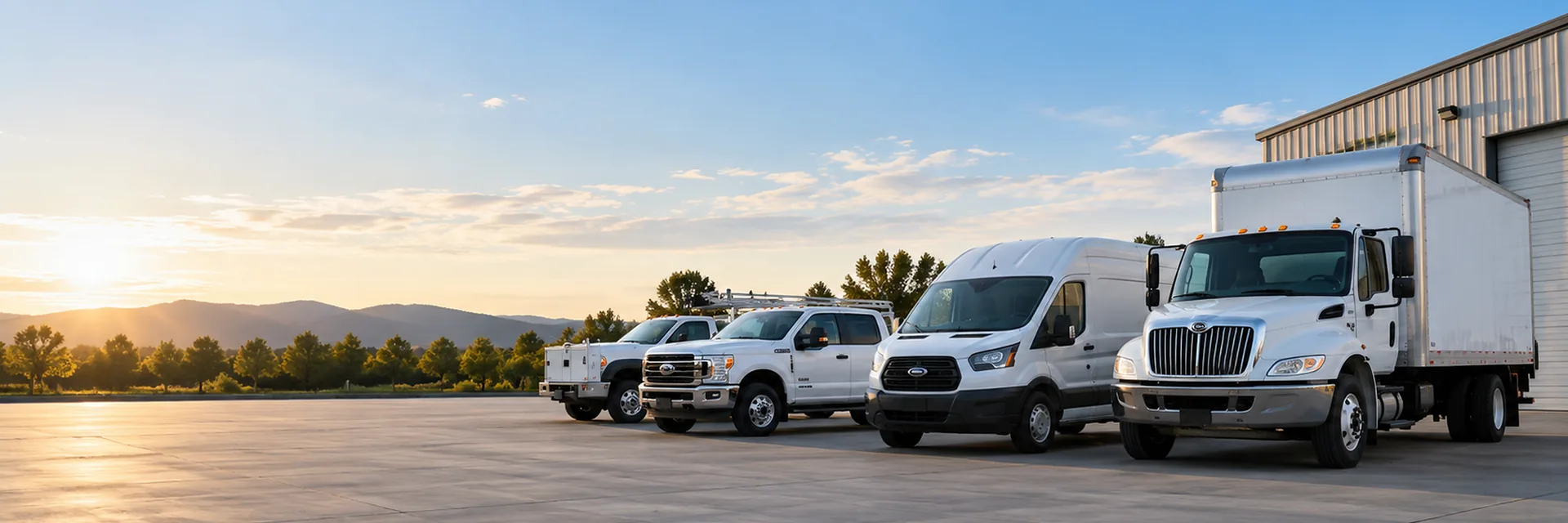
A fleet of commercial work vehicles parked in a row — commercial auto insurance for Utah contractors

Utah commercial insurance

Utah — Commercial Auto Insurance

844-97-USAVE

A work truck used across Salt Lake City, Provo-Orem, Ogden or anywhere in Utah needs coverage built for that business use — not a personal auto policy that excludes exactly that use once it becomes substantial. Gleason Insurance Brokers is a Utah-licensed broker serving Utah contractors directly — not a single-carrier agent — built for fast, affordable quotes on real construction projects.

  • Owned Business Vehicles
  • Physical Damage
  • Hired & Non-Owned

Reviewed by David Gleason, Principal — October 11, 2026

Next Level Experience. Insurance Done Right.

UtahGeneral information only, not legal advice — illustrative scenarios and coverage, subject to change without notice. Content may be out of date or contain errors, and requirements vary by city, county, state, agency, project, contract, carrier and policy, among other factors; verifying what applies to your own situation is your responsibility. Full disclaimer

Interactive coverage guide

Build a coverage stack around how the business actually operates.

Start with the preselected industry or trade, then adjust the operational questions. The commonly considered stack updates live. Keep the coverages you want GIB to evaluate, remove ones you do not want included in your quote request, and add other available lines before continuing.

Common Starting Coverages

General LiabilityThird-party injury and property damage

What it is

General Liability commonly addresses covered third-party bodily injury, property damage and certain personal or advertising injury claims, subject to the policy.

Why businesses like yours commonly carry it

Businesses commonly use it as a starting liability policy and to satisfy customer, landlord or contract requirements.

Possible coverage gap

General Liability is not intended to replace policies for employee injuries, business vehicles, owned property, cyber events or professional errors.

Learn more about General Liability

Commonly Added Based on Operations

Cyber Liability & Data BreachCyber events, data and system interruption

What it is

Cyber insurance may address certain first-party and third-party losses from covered data breaches, cyberattacks, ransomware and system interruption, depending on the policy.

Why businesses like yours commonly carry it

Modern businesses commonly rely on email, banking, accounting systems, websites, cloud services and electronic records.

Possible coverage gap

General Liability generally should not be assumed to address data breach response, ransomware or network interruption.

Learn more about small business cyber insurance in California

Exposure-Dependent Coverages

Business Owners Policy / Commercial PackageLiability and property components evaluated together

What it is

A Business Owners Policy commonly combines liability and property coverages for eligible businesses. A Commercial Package Policy may combine multiple commercial coverage parts depending on the account and carrier.

Why businesses like yours commonly carry it

Businesses with premises, contents, inventory or other property exposures may ask GIB to evaluate whether liability and property components can be packaged where appropriate.

Possible coverage gap

Eligibility, included coverages and package structure vary by carrier. Commercial Property may also be written separately rather than as part of a package.

Learn more about Business Owners Policy / Commercial Package
Umbrella / Excess LiabilityAdditional limits above scheduled liability policies

What it is

Umbrella or Excess Liability may provide additional limits above identified underlying liability policies, subject to its own terms and exclusions.

Why businesses like yours commonly carry it

Businesses with larger contracts, vehicles, public exposure or higher severity potential commonly consider additional limits.

Possible coverage gap

An umbrella does not automatically broaden every exclusion or sit over every policy unless the issued terms say it does.

Learn more about Umbrella / Excess Liability

Loading quote and requirements options…

Educational guidance only. Results are not a coverage recommendation, quote, binder, policy interpretation, or guarantee of coverage. Actual needs, availability, forms, limits, exclusions and requirements vary. A licensed insurance professional should review the complete risk and issued policy terms.

Verified Google reviews

What California business owners say about us

5.0 / 5from 7 Google reviews

Reviews reflect individual client experiences and are not a guarantee of coverage, pricing or results.

91 Enterprise LLC

91 Enterprise LLC

March 24, 2026

We are using Gleason insurance for our commercial auto policy and GL policy. David is the best insurance broker I've worked with — very honest, responsive, and knowledgeable. Highly recommend.

Fito Plumbers

Fito Plumbers

February 20, 2026

We have been working with David at Gleason Insurance Brokers for 8+ years. David always goes above and beyond to make sure we have the appropriate coverages. He explains everything in detail and makes sure we feel confident and understand all of our policies. He is always available and responds right away!

Barry Stay

Barry Stay

February 17, 2026

David provides great service and I highly recommend him for your insurance needs.

Why personal auto usually isn't enough in Utah

Personal auto policies commonly exclude or limit coverage once a vehicle is used substantially for business — hauling materials, transporting crews, carrying equipment for Utah contracting work.

If business use wasn't disclosed on a personal policy, a claim risks outright denial — not just a coverage gap down the road. If the driver is your employee, their own injuries from a work crash are generally covered by workers compensation coverage in Utah rather than by the auto policy.

Personal policies often exclude substantial business use
The exclusion turns on actual use, not just vehicle title
Undisclosed business use risks denial of a real claim
Business use commonly creeps in as a company grows

What Utah commercial auto is built to handle

Commercial auto is underwritten for business use from the start, with Utah's Wasatch Front mountain corridor and real winter driving conditions built into the assumption — travel between job sites along I-15 and connecting canyon roads carries different seasonal risk than a flat, warm-climate state.

Physical damage coverage protects the vehicle itself, and tools or equipment carried may need separate inland marine coverage — worth confirming specifically if your crews carry equipment through mountain routes or during winter months.

Underwritten for business use from the start, with Utah's mountain corridor and winter driving conditions built in
I-15 and connecting canyon-road travel carries real seasonal risk a flat, warm-climate state doesn't face
Confirm inland marine coverage for equipment carried through mountain routes or winter months

What drives Utah commercial auto pricing

Vehicle weight, radius of operation, driver records and claims history all factor in — liability exposure, not the vehicle's value, is usually the bigger driver. Seasonal driving conditions along the Wasatch Front carry real weight in Utah specifically — winter driving experience and a vehicle's winter-readiness (tires, chains) are worth documenting for underwriting, not just standard driver records.

Written driver criteria — MVR standards, experience minimums — is one of the more direct levers on long-term pricing, and winter driving experience specifically is worth including in your written criteria if your fleet operates through Utah winters regularly.

Vehicle weight, radius of operation, driver records and claims history all factor in
Seasonal Wasatch Front driving conditions carry real weight — document winter-readiness, not just standard driver records
Include winter driving experience in written driver criteria if your fleet operates through Utah winters

Fleet growth and coverage review

A single truck insured correctly today can outgrow that coverage as vehicles, drivers and mileage increase — revisit the program as operations change.

As vehicles are acquired they should be scheduled right away, and drivers reported before they get behind the wheel.

Revisit fleet coverage as vehicles and drivers grow
Schedule new vehicles promptly, not at renewal
Report new drivers before they start driving
A growing fleet needs periodic program review

Getting Utah commercial auto coverage in place

Send over your vehicle and driver schedule, along with how each vehicle is actually being used.

Gleason Insurance Brokers places commercial auto for Utah contractors — call 844-978-7283 or request a quote to get started.

Provide a complete vehicle and driver schedule
Describe actual vehicle use, not just vehicle type
We place coverage across CA, AZ, NV, TX and UT
Request a quote online, or call 844-978-7283

A realistic scenario: an unreported new driver

A Utah contractor picks up a driver mid-project — covering for someone out, or scaling for a deadline — and doesn't report the addition until renewal, assuming coverage automatically follows the covered vehicle.

A concrete version of this: a Wasatch Front contractor's fleet is registered at Utah's 30/65/25 minimum under Code §31A-22-304, while a Salt Lake City commercial GC's contract requires $1,000,000 combined single limit plus a waiver of subrogation. The registration minimum satisfies DMV requirements only — it says nothing about whether the fleet is actually eligible to work the job.

Illustrative only — this describes a typical pattern, not an actual case or guaranteed outcome. Some carriers require driver approval before coverage applies to that driver specifically. Report new drivers before they start driving, not at the next renewal.

Some carriers require driver approval before coverage applies
Don't assume a policy covers whoever is behind the wheel
Report new drivers before they start driving
This is separate from the vehicle itself being covered

Utah-specific fleet risk factors

Winter driving conditions along the Wasatch Front are a real, seasonal factor for Utah fleets — snow and ice affect both driver safety and vehicle wear in a way that doesn't apply across the full year, and seasonal driver-training or equipment (tire chains, winterized vehicles) is worth building into your fleet safety program rather than treating winter as an edge case.

Utah's legal minimum for vehicle registration is $30,000 per person / $65,000 per accident bodily injury and $25,000 property damage (30/65/25), effective for policies issued or renewed on or after January 1, 2025 under Utah Code §31A-22-304, per the Utah Code §31A-22-304 (Motor Vehicle Liability Policy Minimum Limits). That figure keeps a vehicle legally registered — it's far below what almost any commercial general contractor's insurance requirement actually calls for, commonly $1,000,000 combined single limit or more. Don't confuse the registration minimum with the limit a contract actually requests for that work. When a contract or a lender asks for higher limits than the auto policy carries, the usual answer is umbrella or excess liability for Utah.

Winter driving conditions along the Wasatch Front are a real, seasonal safety factor
Snow/ice affect both driver safety and vehicle wear
Seasonal driver training and winterized equipment are worth building into your fleet program
State registration minimum: $30,000 per person / $65,000 per accident bodily injury and $25,000 property damage (30/65/25), effective for policies issued or renewed on or after January 1, 2025 under Utah Code §31A-22-304

Utah commercial auto submission checklist

Have the following ready for a Utah commercial auto submission:

Vehicle list with VIN, use (owned/leased), and garaging location
Driver list with license numbers and years of experience
3-year loss run / MVR history for each driver
Actual GC or contract-required limits, not just the state registration minimum
Any vehicles subject to DOT/FMCSA regulation (interstate hauling, weight thresholds)

Frequently asked questions

10 questions — start typing to filter

Can I keep my work truck on my personal auto policy in Utah?

It depends on actual use — many personal policies exclude substantial business use. Confirm directly with the carrier.

What triggers the need for commercial auto coverage in Utah?

Titling a vehicle to the business, regularly hauling materials, or transporting employees are common triggers.

Does commercial auto cover tools carried in a Utah work truck?

Not always automatically — tools and equipment are sometimes covered separately under inland marine coverage.

What factors drive Utah commercial auto pricing most?

Liability exposure, vehicle weight, radius of operation and driver records typically matter more than the vehicle's value.

When should I add a new vehicle or driver in Utah?

As soon as it's acquired or hired — report before active use, not at the next renewal.

Do I need higher limits for a larger Utah contracting fleet?

Often yes as project size and contract requirements grow — review limits periodically.

Does Gleason Insurance Brokers place commercial auto coverage for Utah fleets?

Yes — alongside California, Arizona, Nevada and Texas.

How do I get an affordable, fast commercial auto insurance quote in Utah?

Gleason Insurance Brokers is a Utah-licensed broker, not a single-carrier agent, so commercial auto insurance in Utah can be shopped across multiple markets rather than one company's terms. Actual turnaround and pricing depend on submission completeness, the scope of your construction projects, and carrier appetite — share your timeline and budget when requesting a quote so we can prioritize accordingly.

Does Utah's minimum auto insurance satisfy my GC's contract requirement?

Almost certainly not — Utah's legal minimum ($30,000 per person / $65,000 per accident bodily injury and $25,000 property damage (30/65/25), effective for policies issued or renewed on or after January 1, 2025 under Utah Code §31A-22-304) keeps a vehicle legally registered, but most commercial GC contracts require $1,000,000 combined single limit or more. Confirm the actual contract requirement rather than assuming the state minimum is adequate.

If I cancel a Utah commercial auto policy, am I still responsible for premium?

Where a motor carrier filing is attached, generally yes for the notice period that authority requires, because the filing comes off on its schedule rather than on the day the policy ends. The seasonal version of the same question matters along the Wasatch Front: a unit parked for winter still carries whatever filing it held, and dropping coverage instead of adjusting it can leave both a compliance gap and an uninsured truck sitting through a snow-load season. Utah's 30/65/25 registration minimum is separate from any filing, and below what most contracts require.

Additional official resources

Verify current licensing, regulatory and program requirements directly with the responsible agency — this is general information, not legal advice, requirements change without notice, and what is summarized here may be out of date or contain errors. Confirming what applies to your own city, project, contract and policy is your responsibility.

Updated October 11, 2026