Gleason Insurance Brokers

General Liability · Workers' Comp · Commercial Auto · Pollution Insurance · Surety Bonds Start a Business Insurance Quote Today

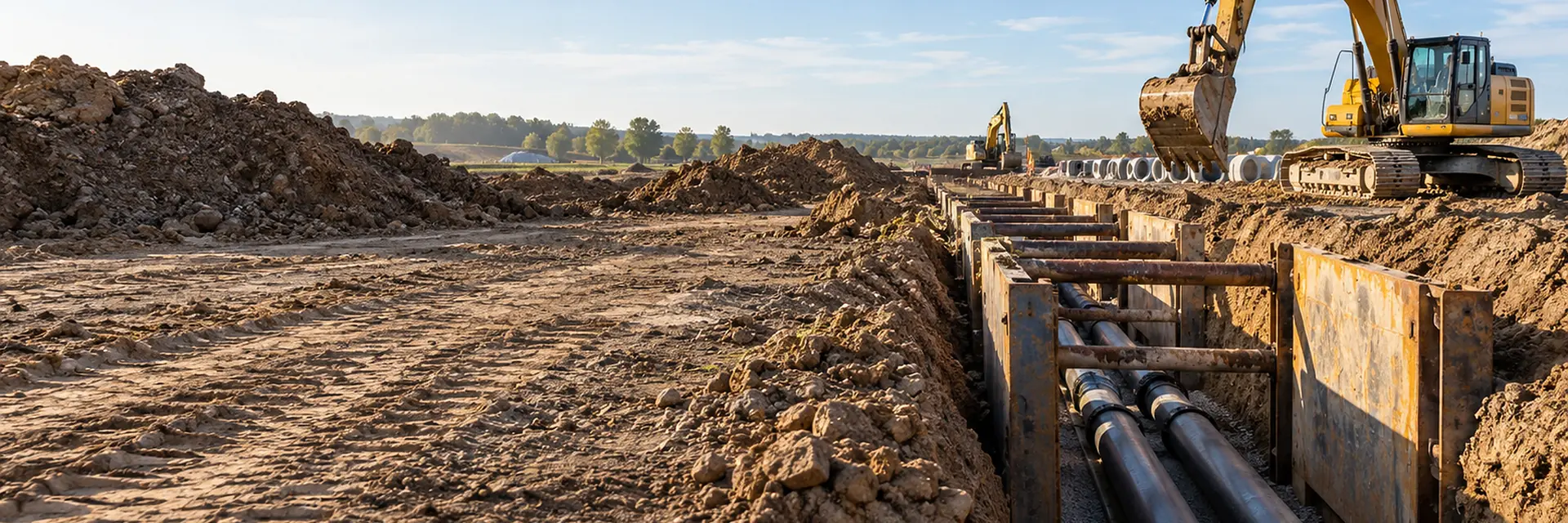
An open trench with underground utility pipe being laid — underground utility, water, sewer and natural gas contractor insurance

California commercial insurance

Utility Contractor Insurance California — Gas, Water & Sewer Main

844-97-USAVE

Gas main, water main, sewer main, storm drain, and underground conduit and telecom/cable construction sit at the heavy-civil end of contracting — buried infrastructure, trench and excavation exposure, utility-strike risk, and public-agency contracts that carry their own specific insurance requirements. Gleason Insurance Brokers builds programs around that exposure, not a generic excavation policy.

  • XCU Coverage
  • Utility Strikes
  • Completed Operations

Reviewed by David Gleason, Principal — October 12, 2026

Next Level Experience. Insurance Done Right.

CaliforniaGeneral information only, not legal advice — illustrative scenarios and coverage, subject to change without notice. Content may be out of date or contain errors, and requirements vary by city, county, state, agency, project, contract, carrier and policy, among other factors; verifying what applies to your own situation is your responsibility. Full disclaimer

Interactive coverage guide

Build a coverage stack around how the business actually operates.

Start with the preselected industry or trade, then adjust the operational questions. The commonly considered stack updates live. Keep the coverages you want GIB to evaluate, remove ones you do not want included in your quote request, and add other available lines before continuing.

Common Starting Coverages

General LiabilityThird-party injury and property damage

What it is

General Liability commonly addresses covered third-party bodily injury, property damage and certain personal or advertising injury claims, subject to the policy.

Why businesses like yours commonly carry it

Businesses commonly use it as a starting liability policy and to satisfy customer, landlord or contract requirements.

Possible coverage gap

General Liability is not intended to replace policies for employee injuries, business vehicles, owned property, cyber events or professional errors.

Learn more about General Liability

Commonly Added Based on Operations

Contractor Equipment / Inland MarineMobile tools, equipment and property away from premises

What it is

Inland Marine is commonly used for tools, equipment and certain mobile property that moves between locations or jobsites.

Why businesses like yours commonly carry it

Contractors frequently move tools, testing equipment and mobile machinery among jobsites.

Possible coverage gap

General Liability should not be assumed to insure the business's own tools and equipment against theft or physical damage.

Learn more about Contractor Equipment / Inland Marine
Cyber Liability & Data BreachCyber events, data and system interruption

What it is

Cyber insurance may address certain first-party and third-party losses from covered data breaches, cyberattacks, ransomware and system interruption, depending on the policy.

Why businesses like yours commonly carry it

Contractors commonly use email, electronic banking, project platforms, payroll systems and cloud document storage.

Possible coverage gap

General Liability generally should not be assumed to address data breach response, ransomware or network interruption.

Learn more about cyber insurance for contractors

Exposure-Dependent Coverages

Installation FloaterMaterials awaiting or undergoing installation

What it is

An Installation Floater may cover certain materials and equipment in transit, temporary storage and during installation, subject to the policy.

Why businesses like yours commonly carry it

Businesses responsible for materials before final installation commonly consider this coverage.

Possible coverage gap

A basic liability policy generally should not be assumed to cover the insured's materials against physical loss before installation is complete.

Learn more about Installation Floater
Builder's RiskProject property during construction

What it is

Builder's Risk may insure covered buildings, materials and certain project property while construction is underway.

Why businesses like yours commonly carry it

Owners, developers and contractors commonly consider it when a structure or major renovation is exposed during construction.

Possible coverage gap

Commercial Property and General Liability are not automatic substitutes for course-of-construction property coverage.

Learn more about Builder's Risk
Contractors Pollution LiabilityPollution conditions and cleanup liability

What it is

Pollution Liability may address covered cleanup costs and third-party injury or property damage arising from pollution conditions.

Why businesses like yours commonly carry it

Businesses working with fuels, chemicals, soil, water, demolition or environmental conditions may have pollution exposures.

Possible coverage gap

Standard General Liability commonly contains pollution exclusions or limitations.

Learn more about Contractors Pollution Liability
Umbrella / Excess LiabilityAdditional limits above scheduled liability policies

What it is

Umbrella or Excess Liability may provide additional limits above identified underlying liability policies, subject to its own terms and exclusions.

Why businesses like yours commonly carry it

Businesses with larger contracts, vehicles, public exposure or higher severity potential commonly consider additional limits.

Possible coverage gap

An umbrella does not automatically broaden every exclusion or sit over every policy unless the issued terms say it does.

Learn more about Umbrella / Excess Liability

Loading quote and requirements options…

Educational guidance only. Results are not a coverage recommendation, quote, binder, policy interpretation, or guarantee of coverage. Actual needs, availability, forms, limits, exclusions and requirements vary. A licensed insurance professional should review the complete risk and issued policy terms.

Verified Google reviews

What contractors say about us

5.0 / 5from 7 Google reviews

Reviews reflect individual client experiences and are not a guarantee of coverage, pricing or results.

91 Enterprise LLC

91 Enterprise LLC

March 24, 2026

We are using Gleason insurance for our commercial auto policy and GL policy. David is the best insurance broker I've worked with — very honest, responsive, and knowledgeable. Highly recommend.

Fito Plumbers

Fito Plumbers

February 20, 2026

We have been working with David at Gleason Insurance Brokers for 8+ years. David always goes above and beyond to make sure we have the appropriate coverages. He explains everything in detail and makes sure we feel confident and understand all of our policies. He is always available and responds right away!

Barry Stay

Barry Stay

February 17, 2026

David provides great service and I highly recommend him for your insurance needs.

Why underground utility work carries its own exposure profile

Underground utility work isn't the same exposure as general excavation, even though the two overlap.

Read more

Buried pipe and conduit work carries a real completed-operations exposure that can surface long after backfill — a failed tie-in, a settled or collapsed main, a damaged conduit found during a later, unrelated dig — and every job also carries a real risk of striking an existing gas, electric, water or telecom line that isn't the contractor's own.

We work with utility contractors across a range of company sizes — meaningful work for municipalities, utilities and larger civil general contractors on the larger end, alongside smaller crews building toward that scale. Program structure, market access and current capacity all factor into how a specific account is approached, whether the business is an established operation adding crews or already running a considerably larger program. The earlier we're part of the conversation, the better we can plan around where a specific account fits. The machines themselves, such as trenchers, vacuum excavators and backhoes, are insured separately under heavy equipment coverage for excavation and utility work.

Buried-infrastructure completed-operations exposure can surface long after the work is backfilled
Utility-strike risk exists on nearly every job, not just unusual ones
Typically licensed under CSLB Class A (General Engineering) or C-34 (Pipeline)
Built around established operations with real revenue, equipment and public-agency work

XCU exposure: the underwriting detail that trips up underground contractors

XCU — explosion, collapse and underground property damage — is a specific, named exposure category that some general liability forms sublimit or exclude outright.

Read more

For a contractor whose work is trenching, boring or laying pipe near existing underground infrastructure, that's not a minor technicality — it's the exposure the trade actually carries.

Confirming XCU is affirmatively covered, not silently excluded or sublimited, is one of the more consequential underwriting details specific to this trade — and one a generic contractor's GL policy doesn't automatically get right.

XCU stands for explosion, collapse and underground property damage
Some GL forms sublimit or exclude XCU exposure entirely
Confirm XCU coverage explicitly — don't assume it's included
Especially relevant to trenching, boring and pipe-laying work

Utility strikes and locate coordination

Striking an existing gas, electric or telecom line during excavation or boring is one of the higher-severity claim types in this trade — third-party property damage, service interruption to the utility, and in the worst cases, bodily injury.

Read more

California's 811 (Underground Service Alert / DigAlert) locate-request process exists to prevent exactly this, and documented, consistent use of it matters to how this exposure is underwritten, not just to jobsite safety.

See our Utility Coordination & Strike Prevention guide for the full picture on managing this exposure in the field.

Striking an existing utility line is one of the higher-severity claim types in this trade
California's 811 locate-request process applies before excavation begins
Documented locate practices matter to underwriting, not just field safety
See our Utility Coordination & Strike Prevention guide for the full picture

Public agency and municipal contract requirements

Gas, water and sewer main work is very often public-agency work — a city, county, water district or gas utility — and public contracts typically carry their own specific insurance exhibit: additional insured status, primary and noncontributory wording, waiver of subrogation, and often a specific limit or endorsement edition date.

Read more

See our Public Works Survival Guide and our General Contractor guide on what it takes to actually get cleared to mobilize on a project like this, not just get a certificate issued. The suppliers providing pipe, fittings and pumps for water and sewer work carry coverage outlined on insurance for pump and waterworks suppliers.

Public agency utility contracts are common in this trade
These contracts typically carry a specific, detailed insurance exhibit
Getting cleared to mobilize means the endorsements are issued, not just requested
See our Public Works Survival Guide for the full requirement pattern

Workers compensation and licensing

Underground utility work is typically performed under a CSLB Class A (General Engineering) license, or a C-34 (Pipeline) specialty license depending on scope.

Read more

Neither classification was part of SB 216's original 2023 mandatory-workers'-comp group — but under SB 1455, every remaining CSLB classification, including these, will require workers' compensation regardless of employee count by January 1, 2028. See our Workers Compensation guide for the full SB 216 / SB 1455 timeline and what it means for an exemption claimed today.

Typically licensed under Class A (General Engineering) or C-34 (Pipeline)
Not part of SB 216's original 2023 mandatory group
Covered by SB 1455's January 1, 2028 deadline for every remaining classification
See our Workers Compensation guide for the full timeline

Sources for this section

A realistic scenario: a buried tie-in, discovered later

A crew completes a sewer main tie-in for a new subdivision phase.

Read more

Eighteen months later, a settlement issue causes a slow leak that damages a neighboring property's foundation; investigation traces the cause back to the original tie-in work.

Illustrative only — this describes a typical pattern, not an actual claim or a guaranteed outcome. Coverage determinations depend on the specific policy and facts involved; for a real, case-specific question, consult a licensed attorney or the appropriate authority having jurisdiction.

Buried-infrastructure claims can surface long after the work is completed
Completed operations coverage is what responds to a claim like this
The scenario above is illustrative only, not a guarantee of how any specific claim is handled

Getting underground utility coverage in place

Describe the actual scope — gas main, water main, sewer main, storm drain, conduit, underground telecom, public versus private work — so the program actually addresses XCU exposure, completed operations, and public-agency contract requirements rather than a generic excavation template.

Read more

Gleason Insurance Brokers places utility contractor coverage throughout California — call 844-978-7283 or request a quote to get started.

Describe the real scope: gas, water, sewer, storm drain, conduit, telecom, public vs. private
Confirm XCU coverage and workers comp status are both addressed
Request a quote online, or call 844-978-7283

Annual encroachment bonds, for contractors pulling permits all year

An underground utility contractor rarely pulls one permit.

Read more

It pulls dozens, across several jurisdictions, in a year — and filing a separate bond for each one is slow enough to affect scheduling. A number of California cities allow an annual bond instead. The City of Fremont's own form is titled an "Annual Faithful Performance Bond for Encroachment Permit Work", and it is written against Chapter 12.05 of Title 12 of the Fremont Municipal Code, which covers excavations, alterations and other uses on City streets and rights of way. Section 12.05.300 is the provision that lets a contractor deposit one annual surety bond "in lieu of separate bonds for each permit".

The mechanics are worth understanding before relying on one. The Fremont form holds the surety for the full period of every permit issued to the principal while the bond exists, and for every renewal of those permits — so the obligation follows the permits rather than the calendar. The surety's only exit is a written notice, and liability continues for thirty days after the city receives it. Nothing that has already accrued goes away when the bond is terminated.

Fremont's encroachment permit covers close to the whole scope of underground utility work: new curb, gutter, sidewalk and underground utilities, repair or replacement of existing improvements, monitoring wells, material storage, and driving trucks and equipment over the curb and sidewalk. The city also lists insurance requirements and surety requirements as separate conditions, so evidence of coverage and the bond are two different items on the same checklist — and the certificate, the bond and the permit are commonly required to carry the same name.

Some cities accept one annual encroachment bond in place of a bond per permit — Fremont's is written against Municipal Code 12.05.300
The bond follows the permits it covers, including renewals, rather than a fixed term
A surety that terminates stays liable for thirty days after the city receives notice, and for anything already accrued
Insurance and surety are separate items on the same permit checklist, not one requirement
Permit, bond and certificate commonly have to be in the same name, which catches contractors operating under a DBA

Frequently asked questions

11 questions — start typing to filter

Does general liability automatically cover explosion, collapse and underground property damage (XCU)?

Not automatically — many general liability forms sublimit or exclude XCU exposure entirely. Confirming it's affirmatively covered is one of the more important underwriting details for any contractor working underground.

What license do underground utility contractors typically hold in California?

Most commonly a CSLB Class A (General Engineering) license, or a C-34 (Pipeline) specialty license depending on the specific scope of work.

Do I need to call 811 before excavating in California?

Yes — California law requires a locate request through the state's 811 (Underground Service Alert / DigAlert) system before excavation. Documented, consistent use of this process also matters to how your liability exposure is underwritten.

Is workers compensation required if I'm a sole owner with no employees?

Not yet for Class A or C-34 specifically — but under SB 1455, every remaining CSLB classification will require workers' compensation regardless of employee count by January 1, 2028, and CSLB is adding a verification process for exemption claims before then.

What's different about a public agency utility contract's insurance requirements?

Public agency contracts — city, county, water district, gas utility — typically carry a detailed, specific insurance exhibit: additional insured status, primary and noncontributory wording, a waiver of subrogation, and sometimes a specific limit or endorsement edition date. Reading it before mobilizing avoids a rejected certificate holding up the project.

Does completed operations coverage apply to a buried pipe or conduit failure discovered later?

Typically, yes — completed operations coverage is what responds when a defect in previously completed work (like a buried tie-in) causes damage that surfaces after the job is finished, which is common in this trade given how long buried infrastructure can sit before an issue appears.

Do utility contractors need pollution liability coverage?

It can apply, particularly on gas main or fuel-adjacent work — see our Contractors Pollution Liability guide for the fuller trigger list this can apply within.

What happens if my crew strikes an existing gas or electric line during excavation?

This is one of the higher-severity claim types in this trade — third-party property damage, utility service interruption, and in serious cases bodily injury. Documented locate-request practices and confirmed XCU coverage both matter here, before and after an incident.

Is a utility contractor the same as a civil contractor?

"Civil contractor" is the broader umbrella term — heavy infrastructure work including grading, utilities, roads and site development, typically under a CSLB Class A (General Engineering) license. Utility contractor work (gas, water, sewer, storm drain, conduit) is one of the main categories of civil contracting, which is why the two terms overlap heavily in how people search for this coverage.

Do subdivision and development projects need this same underground utility coverage?

Yes — installing the water, sewer, storm drain and telecommunications/cable infrastructure that makes a new subdivision buildable is core underground utility contractor work, and developers and subdividers typically require proof of this coverage from every utility sub before work starts. See our developer and subdivider insurance page for the project-owner side of that same requirement.

Can we file one annual encroachment bond instead of a bond for every permit?

In some jurisdictions, yes, and it is worth asking about where you pull permits regularly. The City of Fremont, for example, accepts an annual faithful performance bond for encroachment permit work under section 12.05.300 of its municipal code, deposited once in lieu of separate bonds for each permit. Where one is available it generally covers every permit issued while the bond is on file and every renewal of those permits, which is why cancellation carries a notice period rather than taking effect immediately. Availability, the amount and whether a certificate of deposit is accepted instead all differ by city, so confirm it with the agency's own engineering or public works counter before assuming it applies.

Additional official resources

Verify current licensing, regulatory and program requirements directly with the responsible agency — this is general information, not legal advice, requirements change without notice, and what is summarized here may be out of date or contain errors. Confirming what applies to your own city, project, contract and policy is your responsibility.

Updated October 12, 2026