Gleason Insurance Brokers

General Liability · Workers' Comp · Commercial Auto · Pollution Insurance · Surety Bonds Start a Business Insurance Quote Today

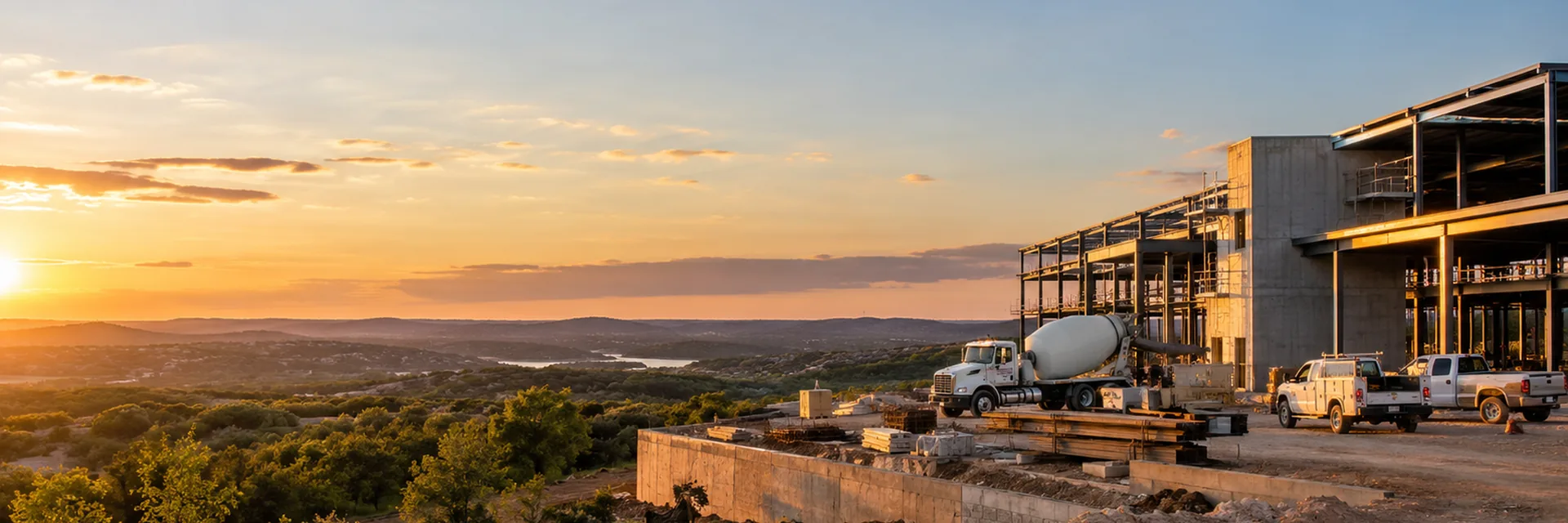
A Texas Hill Country construction site, concrete mixer truck and work pickups at a steel frame building on a limestone pad above a lake — general liability insurance for Texas contractors

Texas commercial insurance

Texas — General Liability Insurance

844-97-USAVE

With no state contractors board setting a licensing baseline, general liability does more of the qualification work in Texas than it does in a licensed state — contracts, cities and lenders lean on it to establish legitimacy that a state license would otherwise signal. Gleason Insurance Brokers is a direct, independent broker serving Texas contractors — not a captive agent — offering fast turnaround and affordable options across construction projects.

  • Bodily Injury & Property Damage
  • Completed Operations
  • City Registration

Reviewed by David Gleason, Principal — October 11, 2026

Next Level Experience. Insurance Done Right.

TexasGeneral information only, not legal advice — illustrative scenarios and coverage, subject to change without notice. Content may be out of date or contain errors, and requirements vary by city, county, state, agency, project, contract, carrier and policy, among other factors; verifying what applies to your own situation is your responsibility. Full disclaimer

Interactive coverage guide

Build a coverage stack around how the business actually operates.

Start with the preselected industry or trade, then adjust the operational questions. The commonly considered stack updates live. Keep the coverages you want GIB to evaluate, remove ones you do not want included in your quote request, and add other available lines before continuing.

Common Starting Coverages

General LiabilityThird-party injury and property damage

What it is

General Liability commonly addresses covered third-party bodily injury, property damage and certain personal or advertising injury claims, subject to the policy.

Why businesses like yours commonly carry it

Businesses commonly use it as a starting liability policy and to satisfy customer, landlord or contract requirements.

Possible coverage gap

General Liability is not intended to replace policies for employee injuries, business vehicles, owned property, cyber events or professional errors.

Learn more about General Liability

Commonly Added Based on Operations

Cyber Liability & Data BreachCyber events, data and system interruption

What it is

Cyber insurance may address certain first-party and third-party losses from covered data breaches, cyberattacks, ransomware and system interruption, depending on the policy.

Why businesses like yours commonly carry it

Modern businesses commonly rely on email, banking, accounting systems, websites, cloud services and electronic records.

Possible coverage gap

General Liability generally should not be assumed to address data breach response, ransomware or network interruption.

Learn more about small business cyber insurance in California

Exposure-Dependent Coverages

Business Owners Policy / Commercial PackageLiability and property components evaluated together

What it is

A Business Owners Policy commonly combines liability and property coverages for eligible businesses. A Commercial Package Policy may combine multiple commercial coverage parts depending on the account and carrier.

Why businesses like yours commonly carry it

Businesses with premises, contents, inventory or other property exposures may ask GIB to evaluate whether liability and property components can be packaged where appropriate.

Possible coverage gap

Eligibility, included coverages and package structure vary by carrier. Commercial Property may also be written separately rather than as part of a package.

Learn more about Business Owners Policy / Commercial Package
Umbrella / Excess LiabilityAdditional limits above scheduled liability policies

What it is

Umbrella or Excess Liability may provide additional limits above identified underlying liability policies, subject to its own terms and exclusions.

Why businesses like yours commonly carry it

Businesses with larger contracts, vehicles, public exposure or higher severity potential commonly consider additional limits.

Possible coverage gap

An umbrella does not automatically broaden every exclusion or sit over every policy unless the issued terms say it does.

Learn more about Umbrella / Excess Liability

Loading quote and requirements options…

Educational guidance only. Results are not a coverage recommendation, quote, binder, policy interpretation, or guarantee of coverage. Actual needs, availability, forms, limits, exclusions and requirements vary. A licensed insurance professional should review the complete risk and issued policy terms.

Verified Google reviews

What California business owners say about us

5.0 / 5from 7 Google reviews

Reviews reflect individual client experiences and are not a guarantee of coverage, pricing or results.

91 Enterprise LLC

91 Enterprise LLC

March 24, 2026

We are using Gleason insurance for our commercial auto policy and GL policy. David is the best insurance broker I've worked with — very honest, responsive, and knowledgeable. Highly recommend.

Fito Plumbers

Fito Plumbers

February 20, 2026

We have been working with David at Gleason Insurance Brokers for 8+ years. David always goes above and beyond to make sure we have the appropriate coverages. He explains everything in detail and makes sure we feel confident and understand all of our policies. He is always available and responds right away!

Barry Stay

Barry Stay

February 17, 2026

David provides great service and I highly recommend him for your insurance needs.

Why GL carries extra weight in Texas

Because Texas has no statewide general contractor license, general liability coverage — along with city-level registration where applicable — is often the primary way a contractor demonstrates legitimacy to a general contractor, lender or project owner.

This makes accurate classification and limits matched to the contracts being signed arguably more important in Texas than in a state where a license number already signals a baseline level of qualification.

The Texas Department of Licensing and Regulation licenses only a handful of trades statewide — electricians and HVAC contractors through TDLR, plumbers through the separate Texas State Board of Plumbing Examiners (TSBPE) — with no equivalent state license or bond for general contracting itself. That's a real, structural difference from Arizona, Nevada and Utah, all of which run a statewide general contractor license. General liability stops at your own payroll: a crew member hurt on the job is a Texas workers compensation question, including the decision of whether to subscribe at all.

No statewide GC license means GL does more qualification work
City-level registration adds another legitimacy signal where applicable
Classification and limits carry extra weight without a state license baseline
TDLR/TSBPE-licensed trades still carry their own state credential

Sources for this section

What general liability covers

GL responds to third-party bodily injury and property damage from your work — completed operations coverage matters here as much as anywhere, since a problem discovered after project completion is a distinct type of claim.

Electricians, plumbers, HVAC and irrigation contractors — the trades Texas does regulate statewide — should make sure their GL classification aligns with their TDLR or TSBPE license, the same discipline as any licensed classification elsewhere. A crash involving a company pickup or a hauling unit falls outside general liability; that exposure is written on commercial auto coverage in Texas.

Third-party bodily injury and property damage from your work
Completed operations coverage for post-project claims
TDLR/TSBPE-licensed trades should align GL classification with their license
Confirm coverage rather than assuming it's included

Contract and city requirements drive the details

Since there's no state-mandated insurance minimum tied to a license, Texas contracts and city registration processes tend to specify their own requirements explicitly — read the actual language rather than assuming a standard limit applies statewide.

General contractors on larger Texas commercial and public projects commonly require additional insured status and specific limits regardless of the absence of a state licensing mandate.

No state-mandated minimum means contracts specify their own requirements
Read the actual contract or city registration insurance language
Additional insured status requires an actual endorsement
Larger commercial/public projects commonly set specific requirements

Exclusions and exposures that matter in Texas

Gulf Coast projects sit within the Texas Windstorm Insurance Association's designated catastrophe-area for named-storm and hurricane wind exposure — that's a property/builders risk consideration, not GL, since GL doesn't respond to storm damage to your own structure. Confirm windstorm terms separately rather than assuming GL or a standard builders risk policy already addresses it.

The Dallas-Fort Worth metro sits at the core of the country's hail belt, among the highest hail-loss-frequency areas nationally — again a property-side exposure on roofing and exterior work, but one that affects how a DFW contractor's overall program (and sometimes GL pricing on roofing-heavy operations) gets underwritten relative to a Houston or Austin contractor with the same revenue. The structure itself, along with materials stored on site, is generally insured during construction under Texas builders risk insurance rather than under this policy.

Gulf Coast named-storm/hurricane damage to structures is a property exposure, not GL
DFW's hail-belt frequency is a real, distinct underwriting factor for roofing-heavy work
No statewide GC license means TDLR/TSBPE classification only applies to those specific trades
Confirm windstorm and hail terms with your property/builders risk carrier separately

Sources for this section

How premium is calculated in Texas

Most Texas GL policies are auditable against actual revenue, payroll or subcontractor cost — an understated estimate typically becomes a larger bill at audit.

Loss history, presented with context on what happened and what changed afterward, gives underwriters something concrete to evaluate.

Most policies are auditable against actual figures
An understated estimate creates a larger true-up later
Document loss history with context, not just a number
Classification accuracy affects rate as much as the estimate

A realistic scenario: classification drift

A Texas contractor's scope of work can shift meaningfully over a year or two — bigger commercial jobs, a new city registration, a different specialty — while the GL policy's stated operations stay frozen at whatever was written when the policy was first bound.

A concrete version of this: a Houston-area contractor doing roughly $1.5M in annual revenue shifts from primarily residential remodel work toward larger commercial buildouts as relationships with general contractors grow, while the GL policy's stated operations and limits stay at what was written two years earlier. Because there's no state license classification forcing a review, nothing prompts an update unless the contractor or broker catches it at renewal.

Illustrative only — this describes a typical pattern, not an actual case or guaranteed outcome. A classification that no longer matches real operations can complicate a claim regardless of fault. Review your stated operations against your actual current work at each renewal, not just at initial binding.

Operations can shift meaningfully between renewals
A stale classification can complicate a claim later
Review stated operations against actual work at every renewal
Not just a one-time-at-binding exercise

Getting a Texas GL quote that holds up

Describe your actual scope of work, the city or cities you operate in, and any specific regulated trade license (TDLR, TSBPE) you hold, along with any contract requirements driving the request.

Gleason Insurance Brokers places general liability for Texas contractors — call 844-978-7283 or request a quote with your operations detail.

Describe your actual scope of work and operating cities
Note any TDLR/TSBPE license held
We're licensed in Texas and four other states
Call 844-978-7283, or submit a quote request to begin

Texas GL submission checklist

Without a state license number to anchor a submission, Texas underwriting leans more heavily on the operational detail you provide directly. Have the following ready:

City registration status for each municipality you operate in (Houston, Dallas, Austin, San Antonio, etc.)
TDLR or TSBPE license number, if you hold one of the state-regulated trades
Loss runs covering three years, and context for anything on them
Revenue split by project type and by metro area
Any Gulf Coast/coastal project flagged for separate windstorm coordination

Frequently asked questions

11 questions — start typing to filter

Does Texas require a specific general liability limit since there's no state contractor license?

No statewide minimum exists — the controlling requirement comes from the specific contract, city registration process, or lender, not a state license mandate.

Do electricians, plumbers and HVAC contractors in Texas need to match their GL to their state license?

Yes — TDLR and TSBPE license these trades statewide, and your GL policy's classification should align with that license the same way it would in a licensed state.

Since Texas has no state GC license, how do I prove legitimacy to a general contractor?

General liability coverage and, where applicable, city-level registration are the primary ways Texas contractors demonstrate legitimacy without a state license number to point to.

Is my Texas GL premium fixed once I bind coverage?

Not necessarily — many contractor GL policies are auditable against actual revenue or payroll, trued up at audit.

Is Gulf Coast hurricane damage covered under my Texas general liability policy?

No — GL responds to third-party bodily injury and property damage, not storm damage to your own structure or materials. Named-storm and hurricane exposure on the Gulf Coast falls within the Texas Windstorm Insurance Association's designated catastrophe area and needs to be addressed on the property/builders risk side, not assumed into GL.

What should I send my broker if a specific Texas contract is driving my request?

The contract's actual written insurance requirements — limits, additional insured wording — not just a certificate holder's name.

Does Gleason Insurance Brokers understand Texas's different regulatory structure for GL purposes?

Yes — we build Texas general liability programs around the state's actual structure rather than assuming a licensed-state framework applies.

Are there affordable general liability insurance options through an independent broker in Texas?

Gleason Insurance Brokers is a Texas-licensed broker, not a single-carrier agent, so general liability insurance in Texas can be shopped across multiple markets rather than one company's terms. Actual turnaround and pricing depend on submission completeness, the scope of your construction projects, and carrier appetite — share your timeline and budget when requesting a quote so we can prioritize accordingly.

What does general contractor liability insurance cover in Texas?

General contractor liability insurance (general liability) covers third-party bodily injury and property damage claims from your operations or completed work. In Texas specifically, since there's no statewide GC license setting a floor, the contract itself is usually what actually sets the required limits and endorsements — read it before binding.

Do paving, excavation and roofing contractors need different general liability in Texas?

The core GL structure is the same across paving, excavation and roofing work, but each carries its own exposure worth describing on the submission — excavation and paving both carry underground/completed-operations exposure, and roofing carries height and hot-work exposure. See our detailed Paving, Excavation and Roofing guides for the trade-specific detail, built from our California program but describing the same underlying exposures.

What should I have ready for a Texas GL submission?

City registration status, any TDLR or TSBPE license you hold, a 3-year loss run, and your revenue split by project type and metro area — see the submission checklist above.

Updated October 11, 2026