
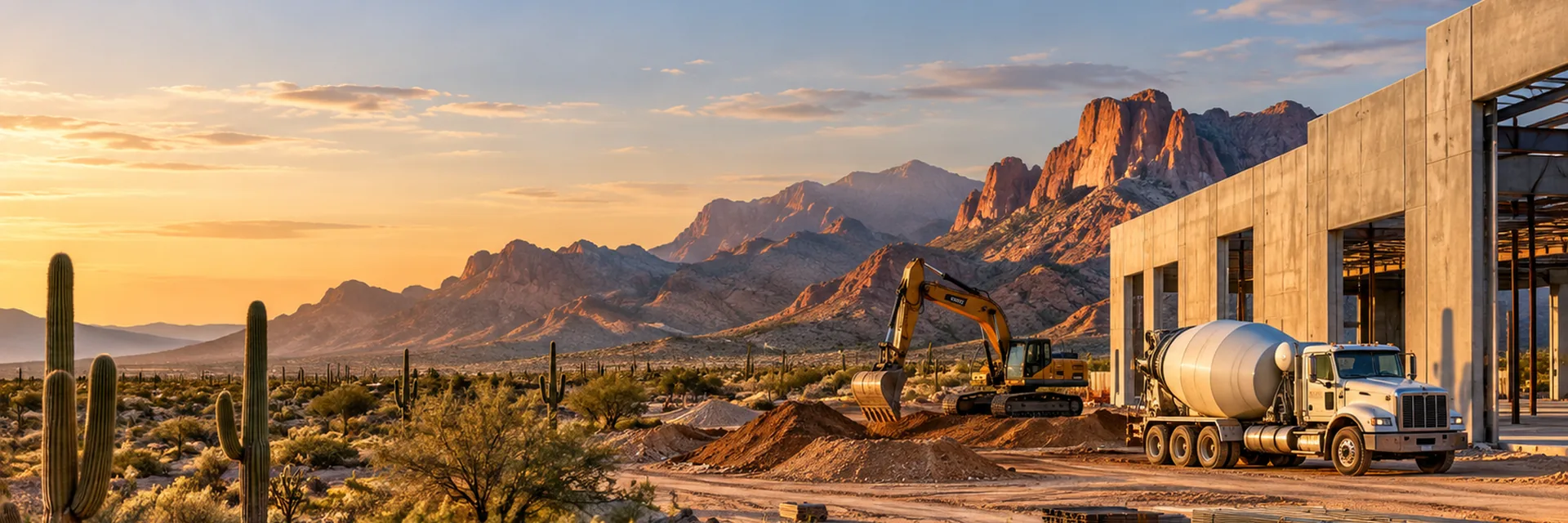
The Tucson construction landscape
Tucson's construction market is steadier and smaller in scale than Phoenix — anchored by the University of Arizona, a significant retirement and active-adult community sector, and continued residential growth on the metro's edges.
Solar installation work has a real presence here as well, alongside standard residential and light commercial construction.
Core coverage for Tucson contractors
General liability and workers compensation form the baseline for Tucson contractors, alongside licensing under the Arizona Registrar of Contractors (ROC).
As fleet size and project value increase, commercial auto, builders risk and umbrella liability get added in — matched to the real operation rather than a one-size-fits-all package. Larger general contractors and public owners in the Tucson area often require limits above a primary policy, usually met with Arizona umbrella and excess liability.
Sources for this section
- Arizona Registrar of Contractors (ROC)Verified 2026-08-22
Utility locating and compliance in Tucson
Arizona 811 is the utility locate service covering Tucson — required before any excavation work.
Additional insured status and specific limits aren't automatic — they come from the GC's, developer's or project owner's contract requirements, and have to be requested explicitly.
Sources for this section
- Arizona 811 — Statewide Utility LocateVerified 2026-08-22
Beyond contractors: developers and restaurants in Tucson
Construction is our strongest focus in Tucson, but the same disciplined submission and coverage-review process extends to real estate developers and subdividers managing project-specific risk, and to restaurants and breweries carrying liquor liability, property and hospitality workers compensation exposure.
It's the same broker and the same process, just a different exposure — one point of contact spanning contractor, developer and hospitality coverage.
What a Tucson-area submission actually needs
Tucson contractors work under the same statewide ROC licensing and bonding structure as Phoenix — there's no separate Tucson-specific registration layered on top, which simplifies the submission compared to states that regulate city by city.
Share your ROC classification, current Tucson-area operations and any general contractor or developer requirements, and we'll build the submission around your actual classification and project mix.
Getting Tucson coverage in place
Describe your actual Tucson operations, typical project type, and any specific contract or licensing requirements so the quote reflects real exposure.
Gleason Insurance Brokers places coverage for contractors throughout Tucson and the broader Arizona market — call 844-978-7283 or request a quote to get started.
Frequently asked questions
7 questions — start typing to filter
What license do Tucson contractors need?
Contractors in Arizona are licensed under the Arizona Registrar of Contractors (ROC).
Which utility locate service applies before excavation in Tucson?
Arizona 811 — Statewide Utility Locate — required before any excavation work in Tucson.
Does Gleason Insurance Brokers place coverage for Tucson contractors?
Yes — we're licensed in California, Arizona, Nevada, Texas and Utah, and place coverage for Tucson businesses directly as part of our Arizona practice.
Do you also cover developers and restaurants in Tucson?
Yes — alongside contractor insurance, we place Developer & Subdivider and Restaurant & Brewery coverage throughout Tucson and the wider Arizona market.
Is workers compensation required for Tucson contractors?
Required once there's any employee, for Arizona employers.
How quickly can contractor coverage actually be put in place in Tucson?
Timing depends heavily on submission completeness and the specific coverage requested — simpler programs typically move faster than ones involving bonds or larger fleets. Sharing prior loss runs and current operations details upfront avoids the back-and-forth that slows most submissions down.
Does Gleason Insurance Brokers need to visit my Tucson location in person?
No in-person visit is required — what matters is accurate information about your actual operations, not physical proximity to a broker's office. This is true across every state we serve — physical distance doesn't change how coverage gets placed.